
Amadeus: Rebel Genius
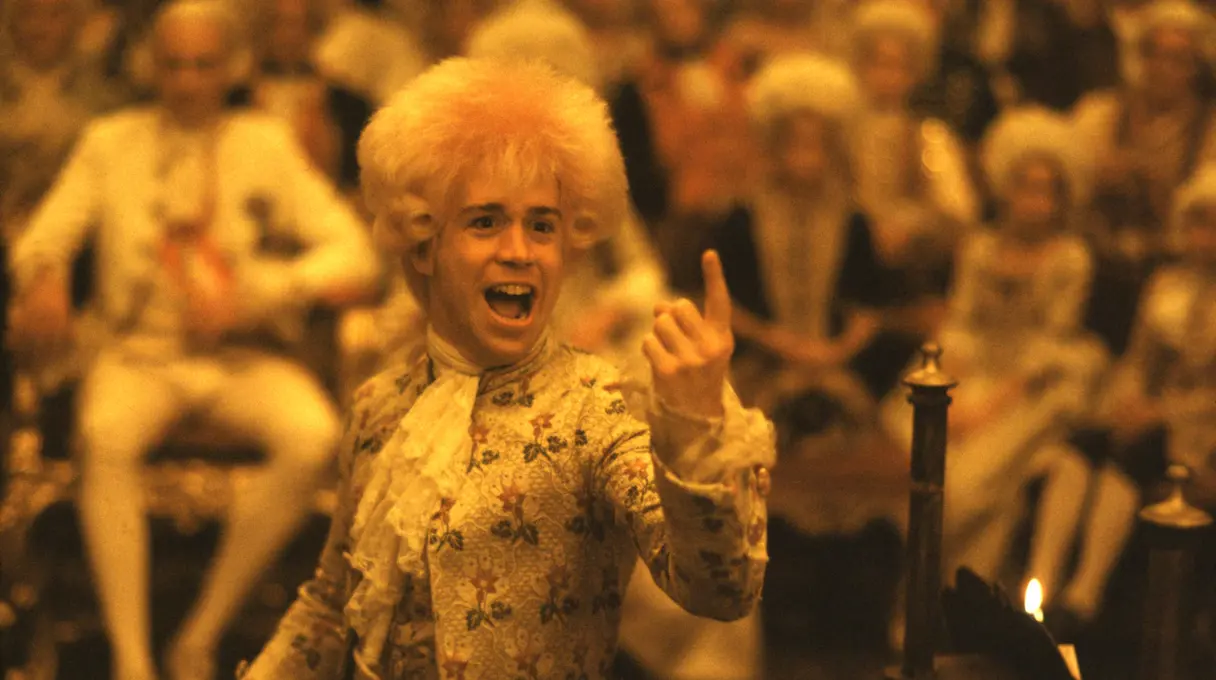

As Miloš Forman’s Oscar-winning drama returns to cinemas, Joshua Bell, the music director of the orchestra that recorded the original soundtrack, the Academy of St Martin in the Fields, welcomes the film’s unexpectedly mischievous portrait of Mozart.
Cinematic forays into the world of classical music are a mixed bag. For every drama like François Girard’s inventive Thirty Two Short Films About Glenn Gould (1993) or his emotionally resonant The Red Violin (1998), many films fail to hit the right chord. As Joshua Bell notes, ‘There are so many cringeworthy films that present the lives of classical musicians and composers. We watch them and think, “You don’t get it. There’s so much more to this than you’re telling.”’
For many, including Bell, Amadeus (1984) set a high bar that other classical-music films should aspire to. ‘What I love about the film,’ Bell says, ‘is that it captures so brilliantly the beauty and complexity of Mozart, which is not an easy thing to do in a mainstream film.’ Key to its success is the soundtrack, which was recorded by the Academy’s founder Neville Marriner and went on to sell 6.5 million copies. Bell replaced Marriner in 2011, while the music played in the film has remained a key part of the Academy’s vast repertoire.

‘I saw the film when it originally came out,’ Bell recalls. ‘But I had seen Peter Shaffer’s original stage play much earlier. I remember being captivated by it. However, the film had a profound effect on me. I was in the thick of the classical world at that time and, of course, I loved Mozart. I made my debut with the Philadelphia Orchestra in 1982 with a Mozart Violin Concerto.’ Bell bought the Amadeus soundtrack as soon as it was released. ‘Little did I know that, two years later, I would be making my first recording with the Academy and Neville Marriner.’
‘Amadeus really managed to appeal to those of us who are very close to Mozart, but also to audiences who were being introduced to him for the first time. I’m sure there were millions and millions of people who had heard of Mozart, but didn’t really know what the big deal was – he was just a name in a history book.’ The film changed that. But far from being reverential, what’s so striking about Forman’s movie – and Shaffer’s screenplay – is the unorthodox way it approaches the life of Mozart and his nemesis, Amadeus’ narrator, Austrian court composer Antonio Salieri (F. Murray Abraham). His first encounter with the young musical prodigy (Tom Hulce) falls short of the decorum he is accustomed to, and his outrage over Mozart’s subsequent behaviour – his crudeness, lecherousness, infantile humour and lack of humility in respecting the gift God has bestowed on him – turns Salieri into his enemy.
Shaffer’s unorthodox approach to Mozart’s life, playing freely with historical facts, results in a singular portrait of a person, time and place. ‘I think Mozart’s foibles are actually part of what’s great about his music,’ Bell says. ‘He’s a complex human being. And to be a great artist, you can’t just be a “serious” individual. He was clearly incredibly empathetic – you can see that in his sensitivity to his opera characters. He was certainly not any kind of idiot savant. He had a lot of wit and, sometimes, vulgarity.’

It’s a mistake, Bell adds, to overlook this element of his work. ‘At times, some of us musicians deify Mozart so much that we leave out his cheekiness, and a lot of it can be found in his music. We have to not be afraid of allowing it to remain in our music making. We might sometimes think of Mozart as this refined character, and his music has to be perfectly phrased in a tapered way, but I think the music demands the sense of mischief that the film captures. It falls in line with the buffoonery of his character in everyday life.’ This doesn’t detract from his talent or body of work. ‘It just makes him a much more complex, profoundly human being.’
Wild, often untrammelled, humour has been a key component in all of Forman’s best work, from early Czechoslovak New Wave satires like A Blonde in Love (1965) and The Fireman’s Ball (1967) through his first Oscar success with One Flew Over the Cuckoo’s Nest (1975) to late works The People vs. Larry Flint (1996) and Man on the Moon (1999). And like Cuckoo, with its battle of wills between psych-ward inmate Randle McMurphy and the controlling Nurse Ratched, Amadeus is driven by the corrosive relationship between Mozart and Salieri.
Of the latter, Bell says, ‘he is portrayed as mediocre, but that’s a little unfair. In terms of musical history he was quite important. After all, he taught Beethoven and Schubert!’ The tragedy lay in the fact that ‘Salieri was good enough to recognise another level existed – one that Mozart worked on and which he could never reach. As he admits, pained but admiringly, of Mozart’s music: “Displace one note and there would be diminishment, displace one phrase and the structure would fall”.’

It’s this contrast of genius and rebel, magician and fool, that makes Mozart and Amadeus so compelling. And the body of work the composer produced, as prodigious as any of the greatest classical composers, was all completed before his untimely death at the age of 35. ‘Can you imagine,’ Bell ponders, ‘what Mozart would have done had he lived for another 30 years? You could already see a trend towards romanticism. There are hints of it in the “D Minor Piano Concerto”, which Beethoven admired and even wrote his own cadenza for. What might have happened had Mozart and Beethoven been around at the same time? Just imagine it.’
This article originally appeared in the Curzon Summer Journal. Pick up your limited-edition copy of the magazine in your local Curzon for free while stocks last.
RELATED ARTICLES

Interview
Hans Zimmer: ‘I Had to Change Style Because Everyone Else was Doing Mine’
List
Best Movie Musical Sequences
With Wicked arriving in cinemas, we salute the most needle-shifting song-and-dance numbers from the best musicals.
Music Documentary