
Bugonia Review: No One’s Doing it Like Emma Stone


Just when you thought she couldn’t possibly push herself any further, the up-for-anything actress throws herself into the role of a villainous, bald-headed girlboss in Yorgos Lanthimos’ kidnapping thriller. By Yasmin Omar
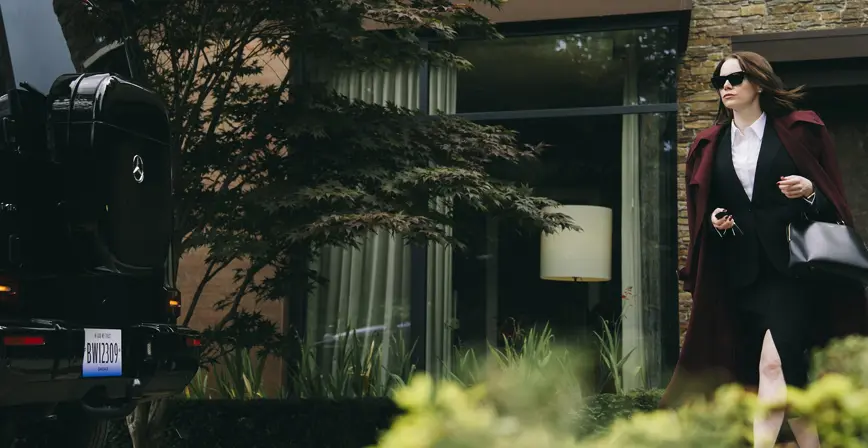
This is how the pharmaceutical CEO Michelle (Emma Stone) starts her day. After waking in her minimalist (and showroom-soulless) mansion, she reclines in a lounge chair flanked by floor-to-ceiling windows, checking her emails through the eye holes of her red-light-therapy mask. Next, she does yoga by her indoor pool, kickboxing in her landscaped garden and interval training on her curved treadmill. She swallows a fistful of supplements, slides on her Louboutins and climbs into her jet-black Mercedes, blasting Chappell Roan’s ‘Good Luck, Babe!’ as she heads to the office.
Her low-ranking employee Teddy (Jesse Plemons), who contributes to her empire by shipping packages from a warehouse, has quite a different morning routine. His warrior poses are performed on a threadbare beach towel in his kitchen, his breakfast is a ketchup-dipped egg roll and his commute is by bike past a dilapidated strip mall.
WATCH BUGONIA IN CINEMAS
Book TicketsThe set-up of Yorgos Lanthimos’ sly psychological thriller Bugonia implies another struggle between the haves and the have-nots. As the past decade of increasingly iterative eat-the-rich satires have demonstrated, the top 1% are today’s socially acceptable punching bag, the people we can comfortably ridicule on screen while squashed under their thumb in reality. But Lanthimos, ever off-kilter in his sensibilities, is too cunning to lead us down such a well-trodden path of toothless barbs and leftist posturing.
Bugonia quickly devolves into something altogether more violent, disturbing and strange. Convinced that Michelle is an alien plotting humanity’s demise, Teddy kidnaps her – with the help of his soft-willed, soft-hearted cousin Don (Aidan Delbis) – chaining her up in his mildewing basement. By Teddy’s calculations, they’re three days removed from the Lunar Eclipse and, when it arrives, he wants Michelle (whom he refers to as ‘it’) to make contact with her species’ Royal Andromeda Court and request extraterrestrials be withdrawn from Earth.

Much like the Frankensteinien brain surgery that sets Poor Things (2023) in motion, Bugonia uses science-fiction scaffolding to meaningfully interrogate the inequality that underpins real-world power structures. Teddy is, in some respects, a Luigi Mangione figure. Similar to the man accused of assassinating UnitedHealthcare’s chief executive, the character is so frustrated by medical-industry profiteering that he has taken drastic action (his mother, we soon learn, was rendered comatose after participating in an unsuccessful drug trial facilitated by Michelle’s company).
On paper, Teddy shares traits with Daniel in Kinds of Kindness (2024), the grieving policeman Plemons plays in the anthology film’s second chapter, who steadfastly believes that his wife (Stone again) is an imposter. But this performance is more erratic and external. Plemons, greasy and lank-haired, taps into the righteous anger of the conspiracy theorist, positioning Teddy as a crusading, self-important vigilante doing his bit for the good of mankind, while failing to recognise the irony that his abhorrent treatment of Don mirrors Michelle’s corporation’s treatment of him.

However good Plemons is – with his wild-eyed paranoia and latent, looming threat – Bugonia will likely be remembered as the movie for which Emma Stone shaved her head. There are few actors who would do anything for a role: Stone is one of them. Lest we forget, she recently took home her second Oscar for Poor Things, which required her to babble like a baby and simulate lots of vigorous sex entirely naked. Stone throws herself body and soul into this part with a complete lack of vanity – show me one of her peers who’s ever been this committed. Once bald, she thickly applies antihistamine cream to each exposed patch of skin, letting it smear on her collar and crust over into whitish scabs on her nose and cheeks.
Michelle – or should that be ‘it’? – is an unflattering character for Stone in terms of both physicality and perception. The late great Robert Redford, for example, refused to be anything less than a hero on screen, and famously turned down the boozing-lawyer role in 1982’s The Verdict (that eventually went to Paul Newman) because the guy’s a loser.
Stone doesn’t think that way. By portraying an unscrupulous CEO accused of decimating the local bee population, establishing a toxic workplace culture and deliberately making people sick for financial gain (among other wrongs), she’s actively confronting the uncomfortable truth of what it means to be a wealthy white woman right now. And this isn’t new for Stone: her blithely gentrifying wannabe reality star in Nathan Fielder’s probing limited series The Curse (2023) was equally compromised; as was her internet-addled tinfoil hatter in this summer’s state-of-the-nation western Eddington. She’s willing to be ugly – spiritually and aesthetically – for the good of a story. And for that we must be thankful.

An early scene with Michelle tells us everything we need to know about her. In the wake of an unspecified corporate scandal, she records an instructional diversity-training video for her employees. Stone, delivering the lines with blank efficiency, stops short mid-speech. ‘It’s too many “diverses,”’ Michelle says of the script. ‘We need to diversify our language.’ To her, the message – which itself makes a rather myopic business, instead of ethical, case for inclusion – doesn’t matter. It’s the presentation: how she and the company will appear.
After grumbled protests, an underling agrees to update the copy, and Michelle retires to her spacious office dotted with her Forbes and Time covers, as well as a trophy imploring ‘Let’s Kick Impossible’s Ass!’ At first, Michelle treats her abductors as she would her staff, imperatively telling them how to resolve the situation they find themselves in. She’s a high-profile female CEO. This simply will not stand. The problem is, her words have power at work, but they don’t in Teddy’s basement. Over the course of the film, Stone adroitly communicates Michelle’s emotional journey from a confident negotiator to a weeping wreck and finally a pleading, spent captive.

Although the ending does somewhat undermine its political potency, Bugonia is still a deliciously nasty little genre movie that criticises late-stage capitalism with Yorgos Lanthimos’ dry humour, toe-curling brutality and cheeky absurdism. Where else can you see a man chemically castrating himself by a campfire? A woman wading through pearlescent pink ectoplasm? A person, immune to gravity, flying high above the ground like a fleshy helium balloon? Well, the latter image did already appear on The Curse, actually. It turns out Emma Stone is at the vanguard of weird and wonderful art in the 2020s.
WATCH BUGONIA IN CINEMAS
RELATED ARTICLES

Review
Kinds of Kindness Review: A Twisted, Troubling Triptych
In his signature dark, disorienting style, Yorgos Lanthimos delivers a star-studded, three-part drama that delves into the disturbing dynamics of abusive relationships, writes Yasmin Omar.

Article
Yorgos Lanthimos' Transgressive Dance Sequences
From voguing in The Favourite to arrhythmic jumping in Poor Things, the dance sequences in the director’s oeuvre reflect wider themes of social rebellion, says Hannah Strong.

Interview