
The Love That Remains: A Family Affair
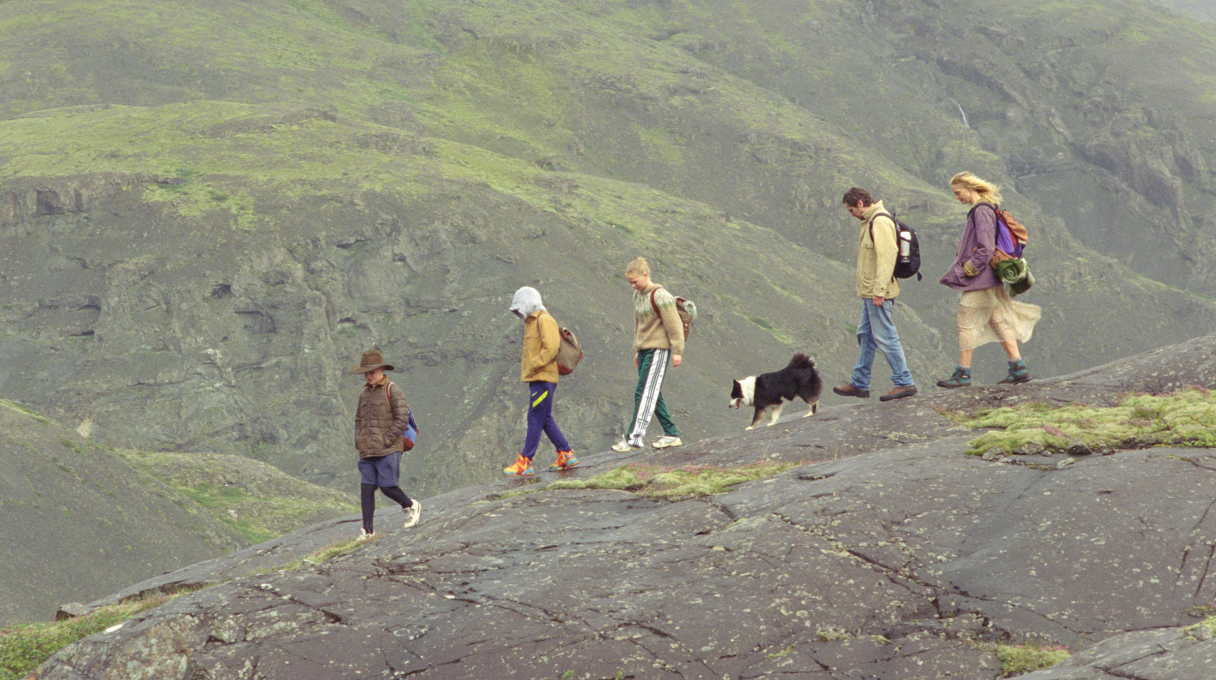

Hlynur Pálmason talks about working with his own family to bring this poetic, lightly surrealist drama to life while employing his visual-art sensibilities to explore the highs and lows of family life.
A unique kind of beauty exists in every frame of a Hlynur Pálmason film. Shot on 35mm film, mostly within a boxy 4:3 aspect ratio, they linger on stark Icelandic landscapes; children’s freckled cheeks, ruddy with cold; the rust on weatherbeaten metal. But Pálmason’s films also move beyond the image itself, exploring their subjects’ relationship with time: of what disappears and what remains as the years pass; how familial relationships shift and old wounds can reopen. His second feature, A White, White Day (2019), an intense thriller about a man discovering his late wife’s infidelity, put him on the map. However, it was the epic yet intimate Godland (2022) – Aguirre, the Wrath of God (1972) by way of Ingmar Bergman – that gained him international acclaim.
Pálmason grew up in Höfn í Hornafirði, a fishing village on the south-eastern coast of Iceland, before moving to Copenhagen for film school, and remaining there for a decade. Now, he has returned to his hometown with his wife and children. This homecoming provided the spark of inspiration that would evolve into The Love That Remains, a stirring family drama that was Iceland's entry for Best International Feature Oscar. ‘When we moved back to Iceland, [the team] decided to buy a 35mm film camera because we wanted to be able to not only shoot during principal photography, which is mostly just two or three months, but also capture all of the seasons, and try to stretch the time over a year or more,’ he recalls. This approach resulted in some of the film’s most striking moments, like the children building Joan of Arc – the dummy knight they use as target practice – who is shot (in more ways than one) in every kind of weather.

Acting as his own cinematographer, Pálmason used ‘short ends’ (leftover pieces of film stock from other projects) to capture whatever caught his eye, such as a crane lifting the roof off his old art studio, where he worked on paintings and photographs, which would become the arresting first image of The Love That Remains. ‘I didn’t always know what I was making, I was just collecting things that I was interested in,’ he explains, ‘and then I used these images to stimulate the writing process.’ It’s an unusual approach to filmmaking that allows for improvisation and play, and is reminiscent of his work as a visual artist. ‘As a filmmaker, you only shoot [once] every three years or so. But if you’re a painter, you can paint every day. And I wanted to work on [my art] every day.’

Out of these fragments emerged three narratives about a family coming to terms with a recent separation. Anna (Saga Garðarsdóttir) is a mother and an artist working with the landscape and struggling to be recognised by galleries. Her ex-husband, Magnus or ‘Maggi’ (Sverrir Gudnason), is a crew member of a fishing trawler, isolated and bitter. And then there are their three children, still in a world of imagination and play: Ída, a teenage girl, and twin boys Þorgils and Grímur, played by Pálmason’s own children (all three of whom share their first names with their characters). The separation is amicable enough that Maggi spends time with Anna and the kids when he’s not out at sea, but not so amicable that they don’t end up at each other’s throats – mutual resentment being impossible to ignore. It’s a picture that poignantly reflects the complexities of life and relationships.
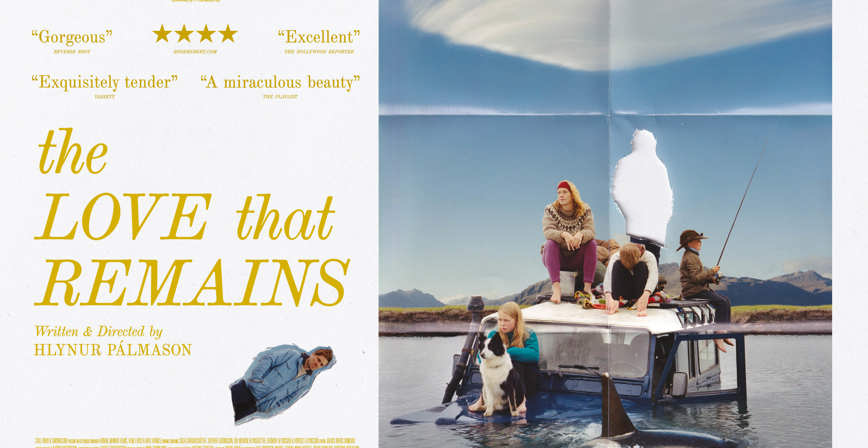
In cinemas from 13 March
Book Tickets NowAs absorbed in the craft as Pálmason undoubtedly is, this film is also a deeply personal project. The director has worked with his own children many times – his daughter Ída appeared in both Godland and A White, White Day – but this was a more conscious attempt to authentically document their spontaneity. ‘I think I’m trying to capture their childhood before it’s too late. One of the biggest motivations to write the film was spending time with my kids – thinking about how precious time is, and that it’s just moving faster and faster,’ he remarks. ‘Because we had a very simple set-up, I was able to film before [we got the] financing. But it’s very hard to capture these [moments] because they’re already gone when you put up the camera.’ And what of the famous maxim to never work with children or animals? ‘It doesn’t make any sense!’ he exclaims. ‘Animals and kids constantly surprise you. There’s something very pure about them on camera.’
Some Cannes Film Festival attendees certainly side with Pálmason here, as the film was awarded the 2025 Palm Dog, the unofficial prize for best canine performance. Indeed, Panda, the Icelandic sheepdog – an ancient breed mentioned in the Icelandic Sagas from over a thousand years ago – is Pálmason’s own family pet. ‘She’s special because she loves to play,’ says Pálmason, ‘and she really listens and understands a lot. You can tell her, “Look like you’re sleeping”, and then she closes her eyes and acts like she’s sleeping. My daughter has been teaching her tricks for a long time and I think that has turned her into some kind of circus dog!’

Like Godland, The Love That Remains also plays with the fantastical and is peppered with absurd moments. A dull, Danish gallery owner abruptly suffers an unpleasant fate; Maggi’s feelings of emasculation manifest as a giant cockerel menacing him after dark; and Joan of Arc, despite being shot through the heart, comes to life. These sequences felt instinctive to Pálmason and a contrast to the prevailing naturalism. ‘The family has a real dynamic and they’re real people. Once I believed that I could push the more expressive things a little bit, even over the edge, I felt that the film could take it without falling apart.’
For Pálmason, it was important that The Love That Remains ‘didn’t become too dark or too light. If it’s too bright and warm, it becomes sentimental. If it’s too dark and cynical, it becomes something that I wouldn’t want it to be’. Therein lies the film’s magic: it’s a balancing act between the warmth within this family, and the anger and alienation; between realism and elements of the mythic. It unfolds like something in between a collection of memories and a dream, one always grounded in profound emotional truth. This is the work of an auteur and artist at the peak of his powers, whose daily practice is quietly honing his skills towards becoming one of cinema’s most revered filmmakers.
THE LOVE THAT REMAINS IS IN CINEMAS FROM 13 MARCH
RELATED ARTICLES
Interview
Director Oliver Laxe Wants You to Feel Sirāt in Your Body
A knife-edge existential drama, Cannes winner Sirāt is one of the awards season’s most strikingly original films. The filmmaker behind it talks spirituality, ceremonial dancing and the choreography of images with Ian Haydn Smith.
Interview
How One Battle After Another's Casting Director Found Chase Infiniti
As her craft is rewarded at the Academy Awards for the very first time, Oscar-winning casting director Cassandra Kulukundis talks through her eight-year journey to find breakout star Chase Infiniti. By Yasmin Omar
Interview
BAFTA-Winning Director Akinola Davies Jr on My Father’s Shadow
The British-Nigerian filmmaker speaks to Josh Slater-Williams about performing masculinity, shooting in Lagos and compiling playlists for his heads of department.