
How 28 Years Later Created a Believable, Post-Apocalyptic World


Supervising location manager Camilla Stephenson scoured Britain and Ireland’s untrammelled countryside, and rewilding estates, to find suitable settings for this skin-crawling zombie horror. By Ian Haydn Smith
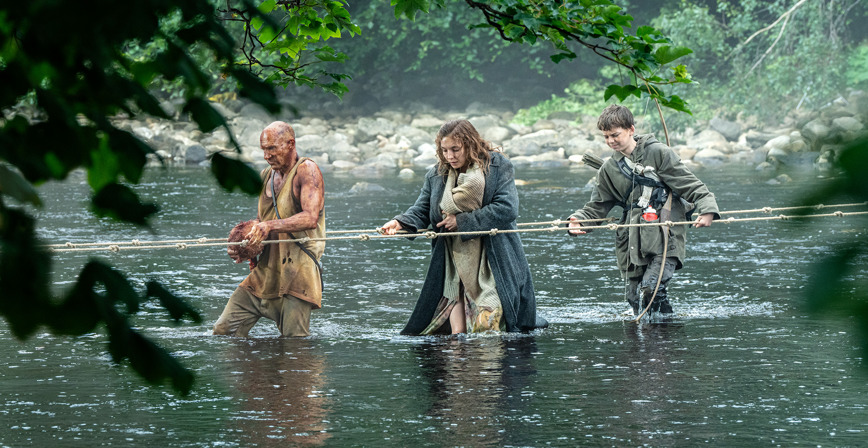
One thing was clear for Danny Boyle and Alex Garland in returning as director and writer to the zombie series they began more than three decades ago. They knew that the locations for 28 Years Later would differ dramatically from what came before. ‘The first thing that Danny said,’ remembers Camilla Stephenson, the film’s supervising location manager, ‘is that this is not an urban film.’ What followed was ‘a fundamental conversation about what Britain could look like 28 years after an apocalyptic event. What would have happened to the countryside, what might happen to anybody who’s managed to survive and what world they have chosen to live in?’. Most importantly for Stephenson and her team, ‘What would that world look like?’
Location can work overtime in a horror film. It’s the most prominent signifier of the environment we trepidatiously journey into. It gives us an idea of what’s coming if protagonists arrive at a cabin in the woods, or by a lake; imports the expectation of a malignant presence in a residential tower block captive; or raises suspicions about the presence of an abject body lurking in the shadows of a solitary suburban home.
WATCH 28 YEARS LATER IN CINEMAS
Book TicketsZombie movies in particular have profited from mining a sense of place, sometimes enriching a film beyond its genre trappings. Nowhere is this more effective than in Dawn of the Dead (1978), the second part of George A. Romero’s groundbreaking zombie series, whose setting in and around a shopping mall brilliantly satirises the rise of consumer culture in Western society. That film, along with Romero’s original, anti-Vietnam War tract, Night of the Living Dead (1968), was a foundational influence for Boyle and Garland’s 28 Days Later (2002).
Their movie opens in an experimental laboratory in Cambridge, with animal-rights activists attempting to free caged chimpanzees, unaware that one has been infected with a highly contagious virus known as ‘Rage’. It then jumps forward, as per the film’s title, to a deserted London, cleverly refashioned into a post-apocalyptic wasteland, before travelling with Cillian Murphy and Naomi Harris’ characters up to Manchester and, finally, to a military compound just outside the city, where a climactic battle between soldiers and infected humans takes place.
Boyle and cinematographer Anthony Dod Mantle’s decision to mostly shoot the film with a Canon XL1 digital camera gave it a gritty feel. This worked particularly well when capturing the movement of the infected/zombie humans; in contrast to the shambling movement of the undead in Romero’s and many subsequent zombie films, the rampaging masses in 28 Days Later move with the speed and agility of a crazed beast.

The 2007 sequel, 28 Weeks Later, directed by Juan Carlos Fresnadillo and featuring Boyle and Garland solely as executive producers, returned the action to London, now a besieged fortress. It made the most of the city’s labyrinthine subterranean network of tunnels, before ending with a brief, but stunning, coda on the Place Du Trocadero in Paris.
The rural setting of 28 Years Later is markedly different from its predecessors. It was the job of Stephenson and her team to find the locations that not only suited the storyline, but which a production – that can eventually reach the hundreds – could work upon. That’s a contrast to the small group usually present at the outset of a feature project, of which Stephenson is key. ‘A location manager in the British film industry is somebody who starts very early on in the process, alongside a very small number of people – normally just a director, a producer and a production designer. We find all the locations and, once selected, we run them on the shoot, right up to the end of it.’

Two major factors face the team at the beginning of any film project. ‘Early conversations cover what the director and the designer hope the film will look like. But it’s the producer who tells you what you can practically do – what the limitations of the budget are and where you can go to find the right location.’ Then, once specific locations have been identified and agreed upon, it’s down to the locations team to seek any authorisation or permissions needed for filming. ‘We are very much part of the logistical side of things. A film in Britain is normally shot between eight and 15 weeks,’ Stephenson says. ‘That usually involves five to six days of shooting each week. You therefore have to be practical about where you can get to in that time and how you can achieve it.’
For 28 Years Later, there was no doubt that the British and Irish countryside would provide the backdrop. And the notion of what this environment would look like, without human intervention for almost three decades, was at the front of Stephenson’s mind. ‘We spoke with people involved in rewilding – visiting estates that had successfully achieved this to get some idea of how the film should look. Our producer said we could go anywhere in the UK and Ireland to do this. So, we journeyed around much of Ireland, Scotland, Wales and England.’

At all times, the location search was aligned to the detailed overview provided by Boyle and, of course, Garland’s screenplay. ‘A key piece of information that Danny gave us was that this is a film with a journey – a sort of road movie wherein characters have to get from A to B. In the end, we decided we would put some truth into that journey. The living exist as a community that has managed to survive on Holy Island. From there came the questions: what does Northumbria look like? Where are they going to end up eventually? And what would that journey be like? We went a bit crazy with that and found all sorts of places to achieve the look we were aiming for. Where it was ultimately shot does detour significantly from the direct route that the characters take.’ It’s a trick that many films use – employing multiple locations to create one cohesive world that audiences can believe in.

A major coup for Stephenson and her team is the location that has been used as the main artwork concept for the film: an enormous tower of skulls. ‘This was a big, big find for us,’ Stephenson says enthusiastically. ‘We required that location for six months, to make it what it needed to be – for it to look right for the film. And it needed to give us a lot of different things. The setting had to be completely believable – that this character had built that structure. What we ended up with was amazing and, like so many of the locations we used in the film, it hadn’t appeared in any film before. That was both interesting and exciting for us. Danny always wanted us to get what we felt was needed for the film. And we felt we achieved it with this.’
RELATED ARTICLES
Interview
Warfare Sound Editor Glenn Freemantle Wasn’t Creating a Hollywood War
Oscar-winning sound editor Glenn Freemantle discusses how he brought authenticity to Warfare's soundscape with every bomb, bullet and show of force.
Review
Mission: Impossible – The Final Reckoning Review: It’s Hard to Say Goodbye
Tom Cruise will break your heart in the last chapter of his celebrated espionage franchise, a self-reflexive, minor-key movie that bids farewell to Ethan Hunt and the gang. By Yasmin Omar
List
15 of the Most Iconic Drivers in Film
In anticipation of this summer's F1® The Movie, we're honouring some cinema's greatest car movies by taking a look at the characters behind the wheel.