
Horror Movies Insist Orphans Are Evil – Bring Her Back Disagrees


The Philippou brothers’ latest film subverts the tired genre trope that parentless children are sinister interlopers and master manipulators seeking to destroy their adopted families, writes Miriam Balanescu.
This article contains spoilers for Bring Her Back.
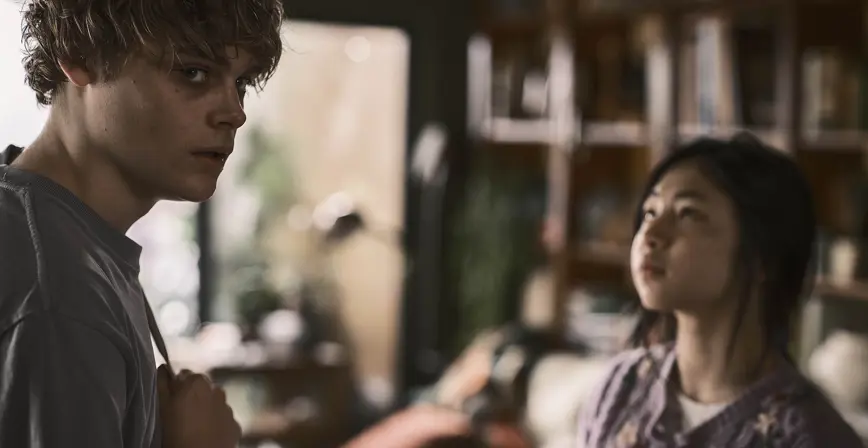
Bring Her Back, Talk to Me (2022) filmmakers Danny and Michael Philippou’s second grisly horror movie about adolescence and grief, begins as two children are orphaned. The younger of the two, Piper (Sora Wong), is partially sighted, but her older brother, 17-year-old Andy (Billy Barratt), is left scarred by the disturbing image of his father’s dead body slumped in the shower. When he meets with a social worker (Sally-Anne Upton) to discuss his and his sister’s move to a new home, she informs him coolly that the foster parent they have found is happy to care for Piper, but reluctant to take in a child like him, whose behaviour is, as their records state, ‘troubled’.
WATCH BRING HER BACK IN CINEMAS
Book TicketsAccording to horror genre convention, Andy would be a classic candidate for the villain of the narrative. A waif with a murky past and mysterious trauma has long been macabre fodder for horror filmmakers, the idea of vengeful orphans popularised in recent years by the Orphan franchise, starting with Jaume Collet-Serra’s first instalment in 2009. In the slasher, remarkably talented nine-year-old Esther (Isabelle Fuhrman) connives to upend a family by dredging up their insecurities, then violently finishing them off. Before I Wake (2016) added a supernatural spin to the orphan horror, as a child’s dreams – and nightmares – enter the realm of reality. In Marrowbone (2017), The Turning (2020) and Mama (2013), orphans are handheld by a malevolent, demonic entity, often raring to make the acquaintance of new foster parents.

But the myth of the evil child goes back much further. In the 1956 thriller The Bad Seed, eight-year-old Rhoda (Patty McCormack) – dressed in pink, her hair in pigtails – initially seems a picture of innocence. However, as a string of deadly incidents takes place, with Rhoda their common denominator, her mother Christine (Nancy Kelly) begins to suspect that her daughter might be less sweet-natured than she had believed. While Rhoda is not an orphan, a secret adoption in Christine’s past is uncovered to explain her bloodthirsty behaviour, warning against bringing an outsider into the family lineage.
Cinematic depictions of orphans have not all been negative. They have stocked the Marvel and DC Universes with superheroes, and fantasy films more widely with ‘chosen ones’, from ‘the boy who lived’ in Harry Potter to the titular Kryptonian in Superman and Spiderman’s webslinger. Yet, in the horror sphere, adopted children are inherently sinister. Stemming back to changeling myths – a folktale, varying across different cultures, in which fairies replace a baby with an otherworldly being – the adopted child on screen has come to embody the ultimate threat to the traditional family. Films like The Omen (1976) whip up fears that there is something innately wicked about taking in a child that isn’t yours. That movie’s five-year-old infant interloper is able to derail not only the conservative American family, but destroy the pillars of US politics. In the folk horror Children of the Corn (1984), an entire society of scythe-wielding orphans run amok, guided only by pagan ritual. Meanwhile, the eerie orphanage setting has spawned a horror subgenre all of its own.

Compared to the legions of crafty children in cinema, sinister foster parents are in significantly smaller supply. In Bring Her Back, by contrast, there is something awry about foster parent Laura (Sally Hawkins) from the offset. Hawkins plays the role with a livewire, frenzied and disconcertingly intense energy, while the boy she has supposedly already adopted, Oliver (Jonah Wren Phillips), has been not only mute but dazed and unresponsive since the tragic drowning of Laura’s daughter Cathy. Laura tends to keep Oliver, whose behaviour is erratic, locked in his room.
Where previous horrors have irrationally cast children as master manipulators, Bring Her Back is a shrewder recalibration of the genre. It’s Laura, not Andy, who pulls the strings. As soon as the pair move in to Laura’s imposing, glass-walled Adelaide home, she begins a devious psychological onslaught against Andy, toying with the residual trauma of his father’s death and – reminding him of his ‘troubled’ history – implying that he has a violent streak that supersedes his protectiveness towards his sister. Laura succeeds in driving a wedge between the siblings. In secret, though, she watches dubious, gruesome Russian videos, which she uses as an instructive guide to the dark art of resurrection, a small giveaway that her deception is heading towards nefarious ends.

Where Orphan, and movies of its ilk, seek to find an external cause for the collapse of a family unit, turning the adopted child into a kind of scapegoat, Bring Her Back understands that the issues lie within. The Australian directors draw a parallel between Laura’s character and that of the children’s father. Both are able to cover up their sustained abuse of the unwitting Andy (and, in Laura’s case, Oliver too), making him out to be a ‘problem child’ when it suits them so that others are blindsided. Laura weaponises her reputation as a long-term social worker, as well as her ditzy personality, using it as a shield against any suspicion that might fall on her.

Instead of deflecting family trouble onto children, Bring Her Back honestly wrestles with the roots of abuse and the fallibility of parents. Like Talk to Me, the Philippous’ new film uses the convulsive language of horror to reckon with grief. This time round, however, the young protagonists are able to come to terms with their loss by accepting their father’s flaws, as opposed to becoming trapped in a demonic realm (which acts as a metaphor for the mental cost of grief in Talk to Me). For all its teeth-grinding gore, Bring Her Back is far more realistic than the litany of portrayals of orphans in horror that have preceded it, where a child’s worst side is often explained away by the occult or possession by the devil. Beneath its blood-spatter, Bring Her Back deeply considers what can go on behind closed doors within a family – and why children should not be solely blamed for their so-called ‘troubled’ behaviour.
WATCH BRING HER BACK IN CINEMAS
RELATED ARTICLES
Article
MaXXXine Laughs in the Face of Elevated Horror
Modern horror has become obsessed, to a parodic degree, with embedding trauma into its narratives. Here, Billie Walker explores how Ti West’s gleefully gruesome movies both mock, and undermine, so-called ‘elevated horror’.
Article
Sydney Sweeney’s Primal Scream

List
Best Horror Movies
What should you watch for jump-scares and hand-over-the-eyes terror? Consult this list for horror movies all but guaranteed to shock you out of your wits.