
James Gunn Returns Superman to His Roots


Departing from Zack Snyder’s dark aesthetic, the new co-CEO of DC Studios draws on the character’s comic-book past for his reboot, which favours paintbox-bright imagery. Here, Lillian Crawford explores the superhero’s enduring iconography.
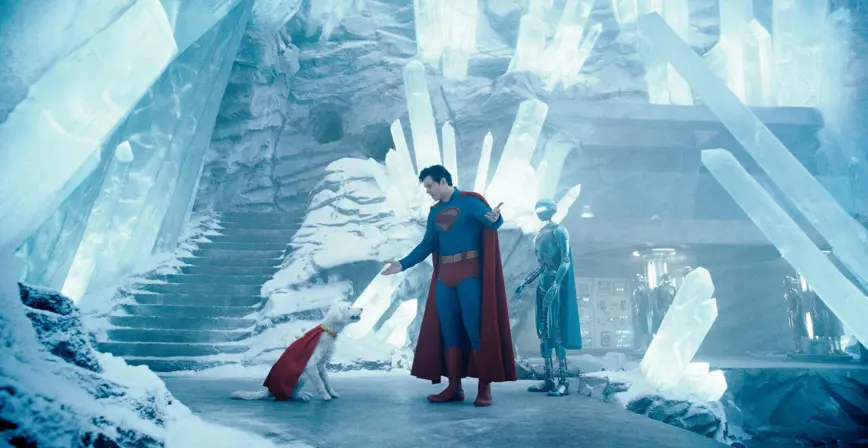
The new Superman, written and directed by James Gunn, begins on an Arctic plain, in media res. We are introduced to David Corenswet’s Kryptonian superhero, near his icy Fortress of Solitude, in the throes of defeat, being dragged across the frozen surface by his fluffy white dog Krypto. Gunn reboots the DC Universe with flashes of familiar imagery – the crimson cape and boots, the diamond-shaped ‘S’ set against yellow and blue, and a revival of the bold pants worn proudly on the outside of his costume. Its bright, cheery and colourful tones pop out of the cinema screen like a freshly printed comic book.
WATCH SUPERMAN IN CINEMAS
Book TicketsThere is a cartoonish quality to Gunn’s aesthetic direction, which deliberately refreshes the look of Zack Snyder’s Superman from Man of Steel (2013) through his black-and-white cut of Justice League (2021). Played by Henry Cavill, Snyder’s interpretation of the hero was older and jaded, with a darker costume that hid his underwear inside his suit. Unlike Gunn, Man of Steel screenwriter David S. Goyer retold Superman’s story from the beginning, with Kal-El’s parents evacuating him from the dying Krypton to Earth, where he landed in Smallville, Kansas, and was raised by foster parents as Clark Kent. It was a gritty take inspired by the box-office failure of the last attempt to reboot the franchise, Superman Returns (2006), directed by Bryan Singer and starring Brandon Roth, which had returned to the character’s comic-book origins. With the ending of the DC Extended Universe and Snyder’s involvement, Gunn has brought Superman full circle.

The character was originally created by writer Jerry Siegel and artist Joe Shuster for the comic book Action Comics #1, published in 1938. Shuster modelled his Superman on American actor Douglas Fairbanks Sr., who played heroes like Robin Hood and Zorro during the silent era, and the pedestrian alter ego Clark Kent on himself and comedy actor Harold Lloyd. On the cover of the issue, Superman is seen holding a green automobile above his head, brandishing huge muscles rendered visible by the tight blue material of his costume. Like Corenswet, he has deep dimples and jet-black hair. It is not only the image that created Superman, but also the one that introduced the world to all superheroes and the archetypal narrative of self-discovery.

The popular image of Superman was lifted off the comic-book page and onto the big screen during the 1940s by Fleischer Studios, founded by animator brothers Max and Dave Fleisher in 1929. Having developed iconic characters such as Betty Boop and Popeye the Sailor, they brought Superman to life in glorious Technicolor for Paramount. They used rotoscoping – that is, tracing animation drawings from live-action footage – to give Superman realistic body movements. The process is not dissimilar to the computer-generated embellishments used by Gunn in the production of the latest film, for example Krypto was 3D-modelled using Gunn’s own pet dog, Ozu. The Fleischer Superman is a direct rendering of Shuster’s drawings, replete with the hero’s iconic fists-on-hips standing stance, albeit with a red ‘S’ emblazoned on the chest against a black-and-yellow diamond.

Superman was fleshed out in a 1948 Columbia Pictures film serial starring Kirk Alyn as Superman, before making his feature debut in 1951 in a cinematic curio entitled Superman and the Mole Men in 1951. Shot in black and white, Clark Kent does not don his Superman costume until midway through the narrative to fend off some children in bald prosthetics, although the film did launch George Reeves as the face of the character throughout the 1950s when the television series Adventures of Superman debuted. Superman became a product of Cold War nuclear paranoia, riding on a wave of popular science-fiction narratives about humans and monsters granted peculiar powers through radiation.

It was not until 1978 that the world was told ‘You’ll believe a man can fly’ by the marketing campaign for Superman: The Movie, directed by Richard Donner. Directly influenced by both Shuster’s drawings of the comics and the 1950s television series, the story of Superman’s journey to Earth and rise as the hero of Metropolis was told by a superteam of screenwriters, including The Godfather author Mario Puzo, and Robert Benton, whose screenplays had included Bonnie and Clyde (1967) and What’s Up, Doc? (1972). The Superman costume, designed by Judianna Makovsky for Gunn’s version, is a direct tribute to the suit created by Yvonne Blake for the 1978 film, with a slight variation on the red-and-yellow breastplate. The brightness of the blue won by Reeve was increased after darker blues caused the suit to appear transparent during the film’s blue-screen sequences, and other shades looked green on camera. A similar hue is worn by Corenswet in Gunn’s version, which asserts its relationship to Donner’s film through reorchestrations of John Williams’ ‘Superman March’ in the new score by John Murphy and David Fleming.

The comic-book version of Superman has also continued to evolve, and Gunn took inspiration from a more modern comic series than Shuster’s 1940s run. All-Star Superman was published by DC Comics from 2005 to 2008, written by Grant Morrison and drawn by Frank Quitely, with digital inking by Jamie Grant. This digital turn away from hand-painted ink drawings creates a smooth, glossy aesthetic similar to that seen in Gunn’s film. It is, however, a darker narrative than the original stories. Superman must contend with his oncoming death as a result of overexposure to Earth’s Sun, as well as his relationship to the world that became his adoptive home. These are questions explored by Gunn’s screenplay, which interrogates Superman’s relationship to political conventions and the importance of popular opinion in the ethics of his heroic practice.

Gunn’s Superman does not rehash its hero’s origins, but rather assumes that Superman is iconic enough through his legacy to tell a new story without relying on too much exposition. While played by new actors, the bald-headed megalomaniac Lex Luthor (Nicholas Hoult) and the sharp-witted journalist love interest Lois Lane (Rachel Brosnahan) feel as familiar as the object of their hatred/desire. Superman is a reboot, but also a throwback – not simply to the iconic 1978 film, but to the early drawings created by Joe Shuster in the 1930s. Gunn might be tasked with bringing DC into the future, but his vision is also laser-focused on the company’s past.
WATCH SUPERMAN IN CINEMAS
RELATED ARTICLES
Article
How to Create a Superhero Universe
Superhero summer is upon us with Superman and The Fantastic Four: First Steps. Here, Helen O'Hara gives studio executives some (mostly) helpful advice on how to build an interconnected cinematic universe that'll keep audiences invested.
Article
A New Chapter of the MCU is Coming
Jess Bacon argues that the studio’s self-referential superhero movies had become too reliant on past victories. But recent developments show that Marvel is clearly turning the page on the Avengers – and constructing an exciting new universe.
Article
Thunderbolts* is the Best Superhero Team-Up Since the Avengers
Marvel has passed the baton to a new group of heroes and, unlike their predecessors, they’re flawed and rough around the edges. It’s these imperfections that make the Thunderbolts a breath of fresh air, writes Jess Bacon.