
Marty Supreme Review: A Portrait of the Athlete as a Young, Selfish Man


In his most self-referential role to date, Timothée Chalamet is a cocky table-tennis player hungrily chasing success in a panic attack of a movie, writes Yasmin Omar.
Josh Safdie’s high-intensity, Fifties-set sports drama Marty Supreme dedicates much of its sweaty runtime to probing the mind of Timothée Chalamet’s intoxicating, insufferable table-tennis aspirant Marty Mauser, a 23-year-old egotist nakedly reaching for greatness. But it starts by probing a body. During the opening credits, Marty, a truculent shoe salesman at this point, is in his employer’s stockroom with Rachel (Odessa A’zion) – a young woman who’s clearly more interested in him than he is in her – snapping her suspender fasteners so they can have covert, clumsy sex on company time.
We cut from their faces to the fleshy topography of Rachel’s uterus, where an army of wiggling sperm are racing towards an egg. One penetrates it, and the zygote transforms into a table-tennis ball. The scene is funny and unexpected – have you ever seen cast and crew names superimposed onto a birth canal? – while also establishing Marty’s priorities. Nothing (not a child, not a lover, not a mother, not a benefactor) will come between him and his ambition to be ‘the face of the entire sport in the United States’.

WATCH MARTY SUPREME IN CINEMAS
Book TicketsLike the pressure-cooker New York thrillers Safdie co-directed with his brother Benny (2017’s Good Time, 2019’s Uncut Gems), Marty Supreme is a panic attack of a movie. The grubby drifters and petty criminals who slink through its underworld have blood that runs hot – and is beaten and stabbed out of them over the most minor of disagreements. Growing up among these types in a rickety tenement building, Marty learned their ways (‘It’s every man for himself where I come from’).
He’s a hustler first, athlete second. Nobody trusts the guy – and with good reason. He begs (on his knees), borrows (from friends) and steals (at gunpoint) to get what he wants i.e. money to fund international flights to table-tennis tournaments. For him, plane tickets to London and Tokyo aren’t a want, they’re a need. Frantically, feverishly, Marty Supreme chases after its restless striver, tailing him down fire escapes and through alleyways as he fumbles to raise thousands of dollars for these trips.
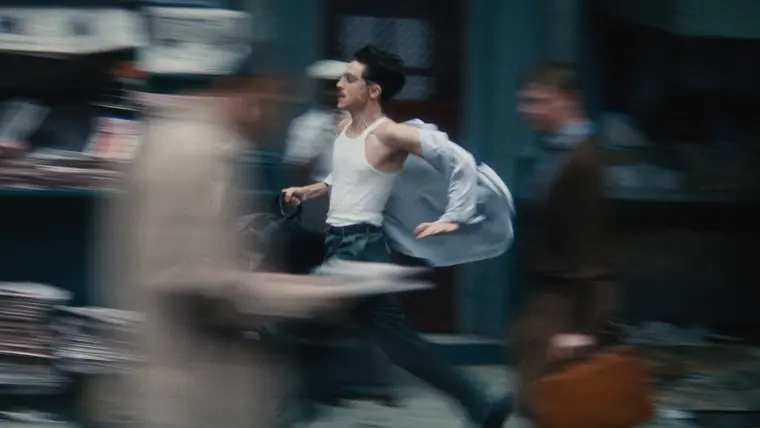
Chalamet infuses Marty with a grasping mania. There’s a rabid desperation, a voracious hunger to him. It glints in his eyes and plays across the smug curl of his lips. Marty Supreme marks a return to form for the actor, who’s largely spent the past two years in the franchise wilderness of Dune’s Arrakis and Wonka’s chocolate shop (with a brief, awards-courting layover in A Complete Unknown’s folk-music scene).
Characterised by bumptious, rapidly delivered speeches and rangy kineticism, Chalamet’s performance mirrors the unrelenting energy of the film itself. Whether he’s sweet-talking a mark or topspinning a table-tennis ball – with credible proficiency, we might add – he thrums with determination. It’s the perfect collision of actor and part: a smashing together of inflated male egos that makes Miles Teller’s asshole drummer in Whiplash (2014) seem like a reasonable, even-tempered guy by comparison.
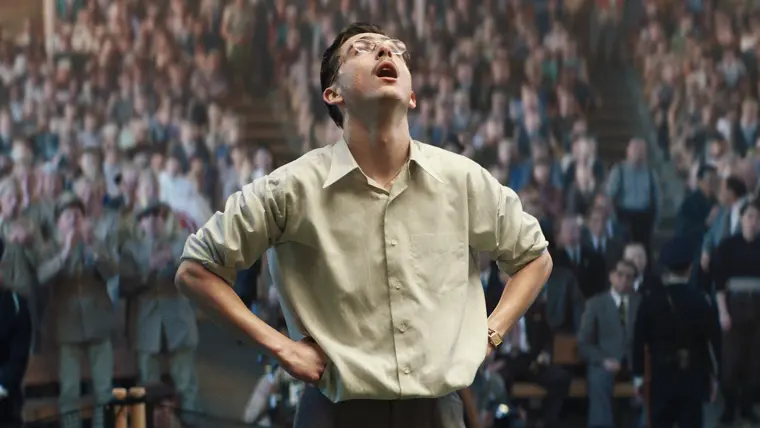
‘The truth is I’m really in pursuit of greatness. I know people don’t usually talk like that, but I want to be one of the greats.’ That’s a Marty Mauser quote, right? Wrong. This is actually what Timothée Chalamet said when collecting his Best Actor SAG in February. The remark caused quite the stir at the time, with some praising his transparency and others lambasting his arrogance.
Not to collapse fiction and reality, but Marty is, by Chalamet’s own admission, the most self-referential character he’s ever played. The wannabe champion (who’s loosely based on the real-life Marty Reisman) is a shadow of his pre-breakout self, the determined, searching up-and-comer willing to sacrifice anything at the altar of his projected brilliance. Both Marty and Timmy want industry domination, come what may.

In this context, it’s wryly amusing to watch Chalamet-as-Marty pitching promotional ideas to further his sporting career, because the actor himself uses each film rollout as an opportunity to solidify – in the parlance of the 2020s – his ‘personal brand’. For Marty Supreme alone, he spent six months designing custom merchandise (for which he’s footing the bill); has surrounded himself with an orange table-tennis-ball-headed army during public appearances; and hosted an 18-minute parody Zoom call where he self-deprecatingly lays out ludicrous marketing strategies. All this extratextual brouhaha only strengthens the film. It demonstrates that this breed of stubborn, driven man has existed since time immemorial.

If Marty casts himself as the greatest showman with a paddle, he forces those around him into the role of bit players in service of his dream. They’re discarded when not of use to him, retrieved once they are. He has a knack for locating people’s motivations, repackaging them to suit his agenda, then selling them back in long strings of manipulative explanation. His affairs with married women – A’zion’s aforementioned Rachel and Gwyneth Paltrow’s fading movie star Kay – are emblematic of this transactional approach to relationships.
Marty is someone who won’t return an ‘I love you’, who smiles at his own reflection mid-coitus. It’s at once repellant and magnetic. His passion for table tennis occasionally spills into his romantic life, and Rachel and Kay gratefully accept the overflow while it lasts. Although Paltrow isn’t afforded much interiority to work with, A’zion certainly is. She’s tough as a housewife who’s aware that pain is just a clenched fist away, and relies on her hard-won streetsmarts to bend situations in her favour.

Marty Supreme has a decidedly Scorsesian sensibility, shades of After Hours (1985) and The Colour of Money (1986) visible in the film’s propulsive editing, jukebox soundtrack and bursts of violence. It sparks with electricity and is resolutely present-tense. Safdie submerges you in moment-to-moment action until you’re gasping for an escape valve to relieve the intolerable pressure (no wonder his previous feature, Uncut Gems, has become a shorthand for intense, stress-inducing cinema). Bobbing and zipping, slashing and thrashing, Marty Supreme is a frenzied portrait of the athlete as a young, selfish man that leaves you, agape, questioning the true meaning of victory.
WATCH MARTY SUPREME IN CINEMAS
RELATED ARTICLES
List
A Brief History of Timothée Chalamet Films
With his indie cachet and blockbuster success, Timothée Chalamet is the hope of Hollywood, one of the few actors under 40 worthy of the term 'movie star'. Here, we round up all the films he's made so far.

Article
Bob Dylan Has Always Been A Complete Unknown
In much the same vein as Martin Scorsese and Todd Haynes’ cinematic portrayals of the enigmatic singer-songwriter, James Mangold’s Dylan biopic wisely leans into his elusiveness, writes Sophie Monks Kaufman.

Review
One Battle After Another Review: A Bold, Electrifying Political Thriller
Leonardo DiCaprio leads Paul Thomas Anderson’s dynamic state-of-the-nation epic, where grenade-tossing, car-flipping action is counterbalanced by dark, satirical humour, writes Yasmin Omar.