
We Need Swearing in Movies

As creature feature Hope faces pushback in its native Korea for ‘excessive’ profanity, David Opie states the case for expletives in cinema, tracing the history of on-screen cursing from silent film to the present day.
This article contains very strong language. Naturally.
When a monstrous alien towers over you, a number of options immediately present themselves. Do you run? Do you stand your ground? Or do you evacuate your bowels and just pass out completely? Before any fight-or-flight response kicks in, the first thing you’d probably do is swear, and that’s true whether said monster approaches you at home or outside a small village in South Korea.
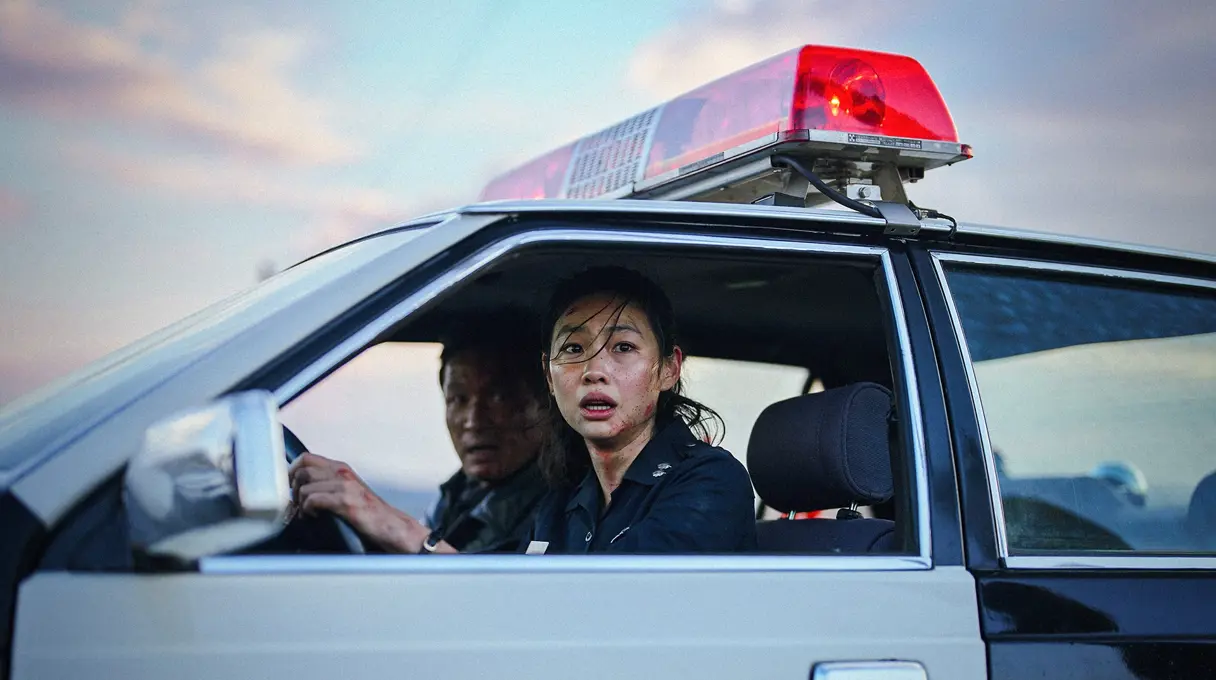
The Wailing (2016) director Na Hong-jin is back with monster feature Hope, reportedly the most expensive Korean film ever made. What's most notable though is how many goddamned swear words Na throws our way in his latest gonzo blockbuster.
WATCH HOPE IN CINEMAS
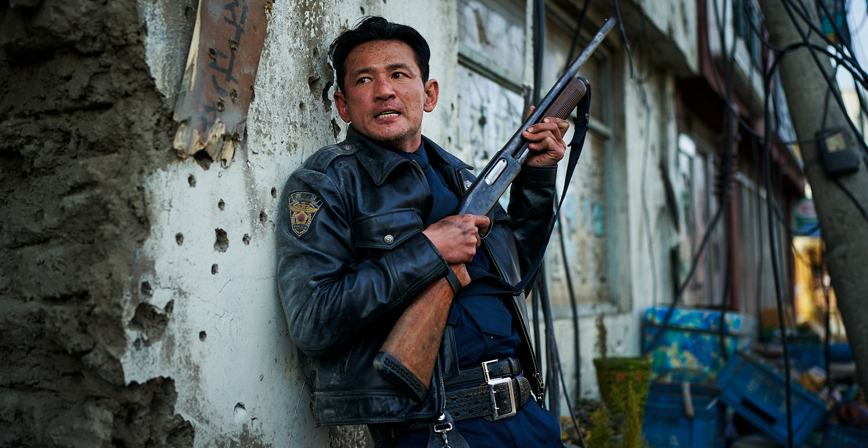
Book TicketsFaced with a ginormous monster that’s torn their town apart, local residents Beom-seok (Hwang Jung-min), Seong-gi (Zo In-sung) and Seong-ae (Jung Hoyeon) let the curse words fly even faster than the bullets they use against the beast in question. Because of this, Korean audiences were polarised by Hope upon its release this summer, with many complaining about the rapid-fire swearing.
According to Na (who also wrote the film’s script), around half of the cursing was improvised, although naysayers may be surprised to learn that a further 200 instances were removed in post-production, leaving around 100 swear words in the final cut.

‘Under circumstances like these – fighting aliens – I thought the dictionary definition of the word needed to change,’ said Na at a Q&A. ‘It becomes an exclamation capable of expressing an entire range of emotions.’
Words like ‘ssibal’ (씨발), aka ‘fuck’ or ‘shit’, are indeed emotive, and the same goes for comparable curses in English. Like any form of dialogue, they’re a means of communication, not just between characters, but also between us and the filmmaker. Used with intention, and timed just right, cursing can transcend mere shock value to better convey a character’s inner world, not to mention the reality of whatever situation they might find themselves in.
Try telling that to early opponents of swearing in cinema though.

There were no rating systems in the silent era of Hollywood, no legislation to monitor or even censor instances of violence and swearing. As such, it’s hard to pinpoint the first time a curse word was actually used on screen, especially as so few films from that era have survived today.
What we do know is that their use predates sound, as seen with the inclusion of ‘damned’ on dialogue cards in the likes of 1925’s The Big Parade. Early talkies continued this trend, with ‘damn’ regularly popping up in early sound movies such as Gold Diggers of Broadway (1929) and Tod Browning’s Dracula (1931). The term was considered harsher back then, which is why it – and many other words such as ‘hell’ and the abbreviation ‘S.O.B’ – were banned when the Hays Code came into effect.
From 1934 to 1968, the Motion Picture Association (MPA) used this measure to sanitise Hollywood filmmaking across the board. But still, that didn’t stop Gone with the Wind (1939) from bypassing censors to give us one of the most iconic quotes in cinematic history.

‘Frankly, my dear, I don’t give a damn’, the famous final words spoken by Clark Gable to Vivien Leigh, has since grown in infamy, not just because it’s often cited as the first example of swearing in a major Hollywood film, but because the line itself is utterly devastating in context. This marks the moment Rhett Butler (Gable) is finally done with Scarlett O’Hara (Leigh), although much of that impact would have been lost had the word ‘damn’ been removed.
An annotated script of the film has since revealed that the line nearly became ‘Frankly my dear, I just don’t care’, to appeal to censors. Legend has it that producer David O Selznick paid a $5,000 fine to keep the original words intact. The truth is that the MPA board passed an amendment to the Production Code a month before the film’s release that allowed use of the words ‘hell’ or ‘damn’ depending on context.

Still, it wasn’t until the Hays Code was put to bed in 1968 that harsher swear words became more commonplace. Robert Altman’s M*A*S*H (1970) is recognised as the first major studio film to include the word ‘fuck’, although a British version of Ulysses (1967) predated that by three years. By the time Jack Nicholson became the first A-list actor to curse on screen in 1971’s Carnal Knowledge – ‘Answer me, you ball-busting, castrating, son of a cunt bitch!’ – cursing was already more accepted on screen.
As in Gone with the Wind, selectively cursing at the most opportune moment often has more impact. Ellen Ripley’s immortal line in Aliens (1986) – ‘Get away from her you BITCH!’ – wouldn’t be remembered today without that emphasis on the word ‘bitch’. Will Ferrell’s 2004 comedy Anchorman smartly toyed with the limitations of America’s PG-13 rating, putting its one allowed use of the word ‘fuck’ to hilarious effect with newsman Ron Burgundy’s sign-off: ‘Go fuck yourself, San Diego’.

Surprise can really maximise that impact, and there’s perhaps no bigger surprise in cinema than hearing the horrors that poured out of Linda Blair’s 11-year-old mouth in The Exorcist (1973). Censorship restrictions had only been lifted a few years prior, but this classic horror made full use of that freedom, shocking with blasphemous utterings like ‘Your mother sucks cocks in hell’ and ‘Stick your cock up her ass, you motherfucking worthless cocksucker’ – each of which really sold this idea of a genuine demonic possession.
Others soon followed suit with foul-mouthed tirades of their own, including Stanley Kubrick’s Full Metal Jacket (1987) and Glengarry Glen Ross (1992), as well as comedies like Planes, Trains and Automobiles (1987). But what of films that embed swearing into almost every other sentence?

Filmmakers like Quentin Tarantino use cursing to create a signature cadence that speaks to the reality of people who often don’t even notice they’re swearing. In a criminal world where morality is distinctly lacking, it would be bizarre to imagine characters like Pulp Fiction (1994) icon Jules Winnfield talk without dropping F-bombs left, right and centre.
Take Goodfellas (1990), for example. When Joe Pesci’s mobster, Tommy DeVito, runs his mouth – ‘Who the fuck cares? I’ll dig the fuckin’ hole. I don’t give a fuck’ – he doesn’t do so for shock value. In fact, the repetitive use of such words actually dulls their impact. Rather than stand out, this cursing ends up having the opposite effect. With each successive ‘fuck’, the swearing gradually becomes background noise, adding texture to this lawless world that filmmakers like Martin Scorsese are adept at crafting.

In fact, Scorsese is so good at this that many of his films number among the most profane ever committed to celluloid. Casino (1995) is pretty high on the list, for example, but it was The Wolf of Wall Street (2013) that set a new record for most F-bombs: 569, or 3.16 a minute.
Even the film’s protagonist Jordan Belfort (Leonardo DiCaprio) is shocked by this when he first joins Wall Street – ‘I couldn’t believe how these guys talked to each other’ – only to end up cursing as frequently as them once he’s assimilated into their lawless finance world. It’s like he says: this is ‘what money sounds like’.
South Park: Bigger, Longer, and Uncut (1999) gave Scorsese a run for his money though, including more than 400 swear words across musical numbers like ‘Kyle’s Mom’s a Bitch’. The difference here is that directors Trey Parker and Matt Stone deliberately overdid it to satirise the censorship of vulgarity in the media. Their aim was to point out the inherent hypocrisy of those who condemn ‘dirty words’ while accepting and even propagating far more dangerous ideals.

Swear words are inherently political in that sense, as is true of anything people wish to censor. Religious, conservative ideals are often what drive this pushback, regardless of the intent behind such dialogue, and cultural differences can magnify this divide too. It’s no wonder that the sheer volume of ‘ssibals’ in Hope didn’t sit right with some cinemagoers in Na’s native Korea. Between the country’s traditional Confucian values and a political conservatism rooted in ongoing conflict, ‘needless’ swearing was always going to polarise audiences.
Yet you’d be hard-pressed to find a film where the profanity is actually needless. Whether it’s included to express humour, satire or, as Na puts it, ‘an entire range of emotions’, swearing is just as vital as any other form of dialogue. Because honestly, how else should one react to the arrival of a killer alien? Hope won’t get you far, but a hearty ‘fuck’ or even a ‘ssibal’ can help bring a cathartic release, a way of coping in the moment when you’re fighting for your life.
WATCH HOPE IN CINEMAS
RELATED ARTICLES
List
The Rom-Com Tropes Popularised by It Happened One Night
List
The Wolf of Wall Street Supporting Characters – Ranked by How Depraved They Are
List