
Why Cinemas are the Ultimate Locations for Period Films
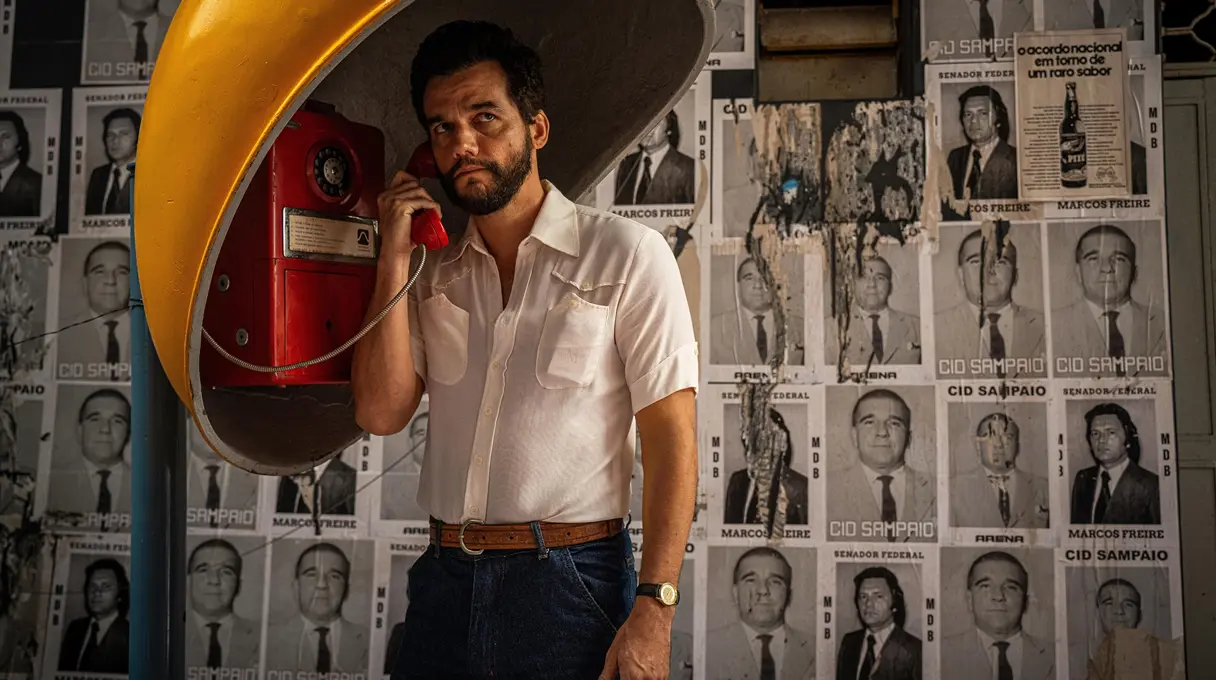

With Oscar-nominated The Secret Agent staging key scenes in a Brazilian cinema, Josh Slater-Williams examines how period films have long used movie palaces to comment on the cultural and political climate of the era they’re depicting.
Early on in The Secret Agent, which is set in 1977, little boy Fernando (Enzo Nunes), is shown drawing his own version of the famous main poster for Jaws (1975). As a visual reference, he’s got a newspaper advertisement promoting the return of the blockbuster to cinemas in the Brazilian city of Recife where he lives. Fernando asks his grandfather, Sr. Alexandre (Carlos Francisco), when he’ll actually be able to see Jaws; the old man explains that the film’s age certificate prevents the child from entry. Alexandre should know, as he’s a projectionist at the Cinema São Luiz, which will have shown Jaws constantly during its initial run. ‘Plus, you’ll have nightmares,’ the grandfather adds. ‘I already have nightmares,’ Fernando replies, making a case for why he should get to experience the cultural phenomenon like everyone else.
WATCH THE SECRET AGENT IN CINEMAS
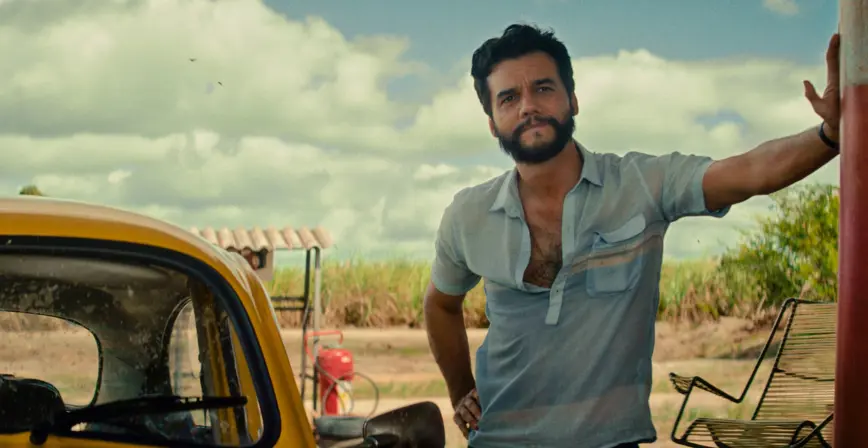
Book TicketsA novelistic, often genre-bending political thriller, writer-director Kleber Mendonça Filho’s The Secret Agent is about a plethora of different things across its sprawling runtime, many of which concern life under military dictatorship and the means by which one’s legacy might be preserved long after they’re gone. But that Jaws poster scene, in tandem with several sequences set at the grandfather’s workplace, specifically speaks to Mendonça’s particular fascination with moviegoing as an act of bringing people together, across generations and walks of life, to share in a collective experience and cultural memory. Within a few minutes of first arriving at the cinema, lead character Armando (Wagner Moura) witnesses a full spectrum of reactions to The Omen (1976): from protests and panic attacks in the lobby to passionate screams and apparent hanky-panky inside the auditorium.

Prior to his latest fiction feature, Mendonça used the documentary Pictures of Ghosts (2023) to explore social changes in Recife through its history of moviegoing. Much of his research for Pictures of Ghosts informed the writing of The Secret Agent, with many of the same cinemas – some of them long closed – appearing as recreated locations or at least referenced in the newer film. Additionally, both the styling and mannerisms of Sr. Alexandre’s character are modelled on a projectionist that Mendonça interviewed as a much younger man, footage of whom appears in that documentary.
It’s difficult to conclusively say whether movies or recorded music were the most influential popular art form of the 20th century, but cinemas themselves have a valid claim for being considered the definitive monocultural destination. Not every concert venue in any given town or city can realistically bring in the most popular musicians around, and a musical act’s performance on one side of a country is never going to be exactly the same as their show on another. But should a cinema’s programmers want to put on a distributed film that’s in circulation in their territory, they can usually do so. And bar any projection malfunctions or sneaky local censors, moviegoers in one town are getting to experience the piece of art in the same form as those in another, or even audiences across the globe.

In this sense, cinemas are an ideal setting for period films like The Secret Agent, where filmmakers are looking to convey something texturally about the cultural and/or political climates of the times. After a certain point in the 20th century, television also worked as a valid device through which to transmit a sense of news stories and social issues that defined the historical period in which a film’s story is set. But while TV broadcasts can be viewed by millions, the cinema experience presents a greater sense of community, even with complete strangers. Moviegoing is inherently a less passive act, in that you have to actively leave your home and go to a specific place.
People have to choose to go and spend their time in a cinema, making the sight and atmosphere of a packed screening a more meaningful device for filmmakers using such venues as a primary location. Or the sight of a virtually empty cinema in the case of writer-director Peter Bogdanovich. His 1971 adaptation of Larry McMurtry’s novel The Last Picture Show, set in 1951, links both the coming of age of various high schoolers and the dying economic prospects of their north-Texas hometown to the local cinema’s slow death – the teenage characters feeling that a stage of their lives is ending just as that once thriving communal hub closes its doors with little fanfare.

In period films like Terence Davies’ Distant Voices, Still Lives (1988) and The Long Day Closes (1992), the cinema can serve as a vital escape for working-class youths from the burdens of repressive or even abusive home lives, igniting imaginations to enrich their otherwise narrow physical environments. For the six-year-old protagonist of The Spirit of the Beehive (1973), meanwhile, a mobile cinema’s screening of Frankenstein (1931) inspires a unique interpretation of the confusion and suspicion rampant in the immediate post-Civil War Spain of 1940.
Rather than solely serving as an escape from the miseries outside their doors, cinemas in period films can also have a more symbiotic relationship with the historical circumstances of the surrounding story. In Joe Dante’s wonderful comedy Matinee (1993), for example, a small-time film producer (John Goodman) comes to a Floridian coastal town with a naval base during the height of the 1962 Cuban Mission Crisis. There to preview his latest B-movie, the William Castle-esque showman capitalises on the hysteria of imminent nuclear war, with an immersive screening that, thanks to various unpredictable mishaps, begins to seem all too real for the patrons.

Largely set in 1940s and 50s Sicily, Giuseppe Tornatore’s Cinema Paradiso (1988) is perhaps the most famous example of a period film essentially using a physical cinema as an avatar for a place and people’s fortunes in the aftermath of war that actually came to pass. It’s a film that revels in the tactile, physical intimacy of traditional projection long before digital, though the terrifying fire that closes its first act highlights the inherent danger to the magic of the movies when flammable nitrate film was still the norm – something Quentin Tarantino exploited for all its worth in the explosive finale of Inglourious Basterds (2009).
In Cinema Paradiso, that frightening near brush with death and destruction doesn’t deter young Toto (Salvatore Cascio) from the movie palace – the boy eventually grows up to become a film director himself. Like with Jaws-obsessed Fernando in The Secret Agent, the risk of nightmares, of pictures of ghosts haunting you long after the credits roll, is an intrinsic part of the theatrical experience. This remains as true for the present as it did for the past.
WATCH THE SECRET AGENT IN CINEMAS
RELATED ARTICLES
Article
Why Do Filmmakers Keep Whitewashing Gothic Literature?
As another white actor takes on the canonically brown role of Heathcliff, Nadira Begum investigates the worrying trend of directors refusing to engage with the racial politics of Gothic novels when bringing them to the big screen.
Article
Rose Byrne’s Comedic Skills Power If I Had Legs I’d Kick You
There may be panic attacks and anxiety spirals in this high-intensity drama, but the brilliance of Rose Byrne’s Oscar-nominated performance is rooted in her facility with comedy, writes David Opie.

Interview
How One Battle After Another's Casting Director Found Chase Infiniti
As her craft is rewarded at the Academy Awards for the very first time, Oscar-winning casting director Cassandra Kulukundis talks through her eight-year journey to find breakout star Chase Infiniti. By Yasmin Omar