
Jessica Henwick: I've Been Really Creatively Fulfilled Working with New Directors
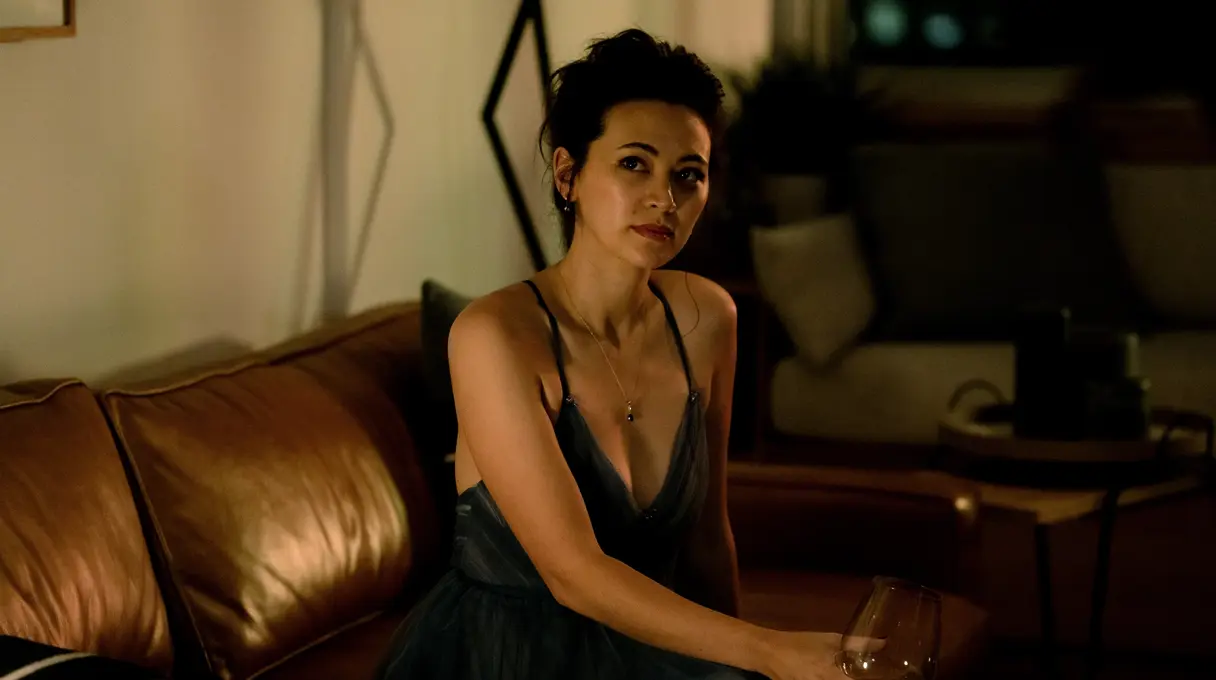

The How to Make a Killing star discusses prioritising independent-film projects, preparing for her directorial debut and leaving hustle culture behind. By Josh Slater-Williams
‘Oh gosh, sorry, I’m just looking at this.’ Approximately three minutes into our conversation, Jessica Henwick finds herself slightly distracted and very amused. ‘This is the busiest armchair backdrop I’ve ever had for an interview. This is not my house, OK? Please don’t judge me on this!’
Not to compare the English actor to the patterned, shocking-orange furniture she’s sitting on, but this moment of a scene partner of sorts stealing her attention is strangely appropriate for Henwick as a performer. Whenever she shows up in a film, no matter how big or small her part, or how famous her onscreen castmates (as in 2022’s Glass Onion: A Knives Out Mystery), you’re always drawn to what she’s doing.
And not because she’s incongruously showy; rather, her characters always feel like tangibly real people with genuine, relatable reactions to even the wildest situations. From the aquatic horror Underwater (2020) and Sofia Coppola’s On the Rocks (2020) through to legacy sequel The Matrix Resurrections (2021) and her co-lead role in thriller The Royal Hotel (2023), Henwick is a regular scene-stealer. She gives so much for her co-stars to work with and play off that whatever effect, texture or message her director is aiming for achieves maximum impact.
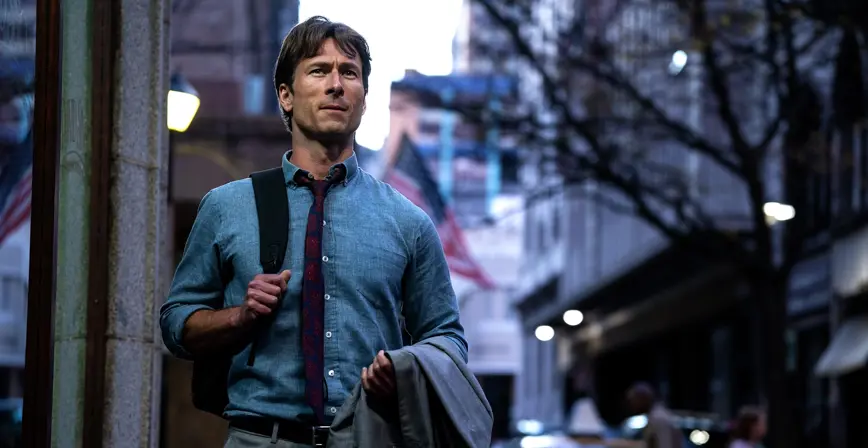
WATCH HOW TO MAKE A KILLING IN CINEMAS
Book TicketsHenwick’s latest big-screen part is a masterclass in being the moral centre of a film – despite not being top-billed. ‘I totally agree that she is the only good character,’ she says with a chuckle. A loose reimagining of the British dark-comedy classic Kind Hearts and Coronets (1949), the US-set How to Make a Killing sees blue-collar thirtysomething Becket Redfellow (Glen Powell) become inspired to make up for a life of missed opportunities, connecting with extended family members he’s never known by orchestrating their murders to look like accidents.
Why such a dramatic approach to meeting his kin? Well, Becket’s mother Mary (Nell Williams) was disowned by her father, Whitelaw (Ed Harris), when pregnant with Becket at a young age. Before she dies, Mary tells her son that legalities mean he is still in the running to eventually inherit the family’s $28 billion fortune. A chance reconnection with his lifelong crush, femme fatale Julia (Margaret Qualley), spurs Becket to wage war on the nepo babies, infiltrating the worlds of various eccentric, often entitled aunts, uncles and cousins until he’s next in line for the inheritance.

Along the way, there’s more than one test of Becket's abilities to do dark deeds, but Henwick’s character, Ruth, proves the most important challenge to his murderous mindset. She’s introduced as the girlfriend of Becket’s idiot-artist cousin Noah (Zach Woods), a self-described ‘white Basquiat’. But that relationship is clearly coming to an end, and instead of ascending a New York City art scene rife with rich kids cosplaying compassion, Ruth sees her calling in the more down-to-earth ambition of high-school teaching.
‘It’s just scary to dream small,’ she says at one point. ‘No one teaches us how to do that.’ Even though Becket has already done very bad things, a burgeoning romance with Ruth, who doesn't know about his scheme, offers a way out of the violent cycle that his big American Dream entails. Whether or not he can resist the pursuit of extravagant wealth above all else is another matter.

‘To get small is something that I think really speaks to people right now,’ Henwick says. ‘Ruth is reflective of a movement away from hustle culture towards slow living and seeking contentment in smaller ways. Homegrown food, gardening, slow releases of dopamine, going analogue – it’s all happening as we speak. The journey she’s going on is also something that a lot of people naturally reach in their thirties. If your twenties are all about chasing the carrot, I think your thirties are about figuring out if you actually like carrots.’
Pitch-black comedy thrillers like How to Make a Killing can be tricky in terms of tonal management, where one or two missteps can sabotage the whole atmosphere or the audience’s investment. Much like how thinking smaller is key to Ruth as a character, Henwick grounding her performance was crucial for the rest of the film to actually work.

‘It’s so fun being on set and getting to see those other actors play these larger-than-life characters,’ she says. ‘Topher Grace chewing scenery, Ed Harris, Margaret Qualley, Zach Woods, [among others]. It was so tempting to slip into that tone, but I also knew that the only reason those bigger characters work is that you have to balance it out with really straight characters. For me, Ruth exists only in tandem with Margaret’s character, Julia. We’re the opposite sides of the same coin, so it needed me to play it straight, honest, empathetic, moral and also fun. But I needed to be someone that the audience could relate to, so that [Julia] could be someone who the audience can’t relate to.’
How to Make a Killing is the second feature from writer-director John Patton Ford, who previously helmed the Aubrey Plaza vehicle Emily the Criminal (2022). Henwick’s next film is another second feature, heist comedy The Roots Manoeuvre from Rye Lane (2023) writer-director Raine Allen-Miller. She’ll also soon be seen in dark-comedy thriller Everybody Wants to F*ck Me, which is the debut feature from writer-director Jonathan Schey. After a decade of steadily becoming something of a franchise queen (with roles in Game of Thrones, Star Wars, The Matrix, Marvel’s TV show Iron Fist and the Knives Out series), Henwick’s recent streak with early-career filmmakers is absolutely intentional.

‘It’s putting your money where your mouth is,’ she tells me. ‘I had been saying for so long that I want to work with more women, people of colour, new directors, fresh voices and non-IP. It just got to the stage where I had to start saying no to the big, crazy machine films and start saying yes to these. And I’ve loved it. I’m really grateful for those other experiences I’ve had and it’s not to say I won’t go back to it, but I have really been creatively fulfilled these last two years working with so many new and interesting directors.’
Working on a smaller scale with directors like John Patton Ford may be helping to inform Henwick’s hopefully not far-off return behind the camera. Having previously directed two shorts, including the BAFTA-nominated Bus Girl (2022), she’s currently trying to get her debut feature funded. ‘My background before directing was primarily TV writing. I know how to write commercially, but I really wanted this to feel so different than anything I’ve ever done. And it is independent cinema with a capital ‘I’. That is hard to get money for because people are looking at their return and it’s a difficult time in this industry. There’s so much in flux right now. But I also think there’s no easy time to sell something. You’ve got to really want it and you’ve got to push it. No one’s going to hand it to you.’

If getting a debut feature off the ground is by no means easy, Henwick is at least broadly encouraged by the improving number of East and Southeast Asian creatives behind the scenes in British film and TV – and the stories they’re telling. ‘It’s much better than it was when I began 15 years ago,’ she says, ‘so I feel quite hopeful actually. There are also a lot of [people like] me – East Asian actors now becoming writers and directors – and that’s exciting too.’
Back in 2010, when Henwick began her acting career leading the BBC series Spirit Warriors, there was so little East Asian representation that authentic depiction of its communities didn’t exist. Compounding the issue to this day is the fact that actors from such backgrounds hardly appear in mass-audience movies and shows, which, according to Henwick, means ‘public consciousness of those stories is diminished’. What can be beneficial in its own way, though, is large-scale productions weaving in meaningful representation that doesn’t dominate the story, but is just explicit enough to really resonate with those who need it the most.

Like so much of director Lana Wachowski’s work, The Matrix Resurrections has proved especially dear to often marginalised queer communities, with Henwick’s action-hero character, Bugs, being embraced as a non-binary icon since the film’s release. ‘It’s definitely something that we were aware of and had talked about,’ Henwick says of that interpretation of the performance and character. ‘And we discussed various versions where it was made more overt. I don’t know how it ended up being that version, which I think is quite subtle, beautiful and necessary in its own way.’
‘“Who’s going to connect to this character?” is not the first thing I think of when I get sent a script,’ she continues. ‘But I definitely think, “Who’s going to connect to this film? Who’s the audience? Is this a story we’ve heard before? Does this story feel timely?” That’s why I found Ruth [in How to Make a Killing] interesting because I found her to be really timely. And that’s quite rare, especially because she’s not the lead, she’s a secondary character. Normally, [they] can feel light and only there to serve some random purpose in the hero’s journey, [while] Ruth really feels like she has her own life outside of Becket. But I love hearing that people have found something that speaks to them. That’s the whole point of what we do. It’s connection. It’s really sweet to hear.’
WATCH HOW TO MAKE A KILLING IN CINEMAS
RELATED ARTICLES

Romantic Films
Anyone But You Review: It’s Exactly What You Expect – And That’s Why it Works

Review
Twisters Review: The Dumb Fun Summer Blockbuster We Need
Glen Powell proves his leading-man chops as an arrogant storm chaser in Lee Isaac Chung’s entertaining, silly spectacle, where bricks cascade, hay bales fly and cars aquaplane. By Yasmin Omar
List
Top 21 Films About Money
As Channing Tatum plays an alluring tech billionaire with a private island in Blink Twice, we round up the 21 best films about the corrosive effects of money.