
Oscar Winner Mike Hill on Designing Frankenstein's Creature
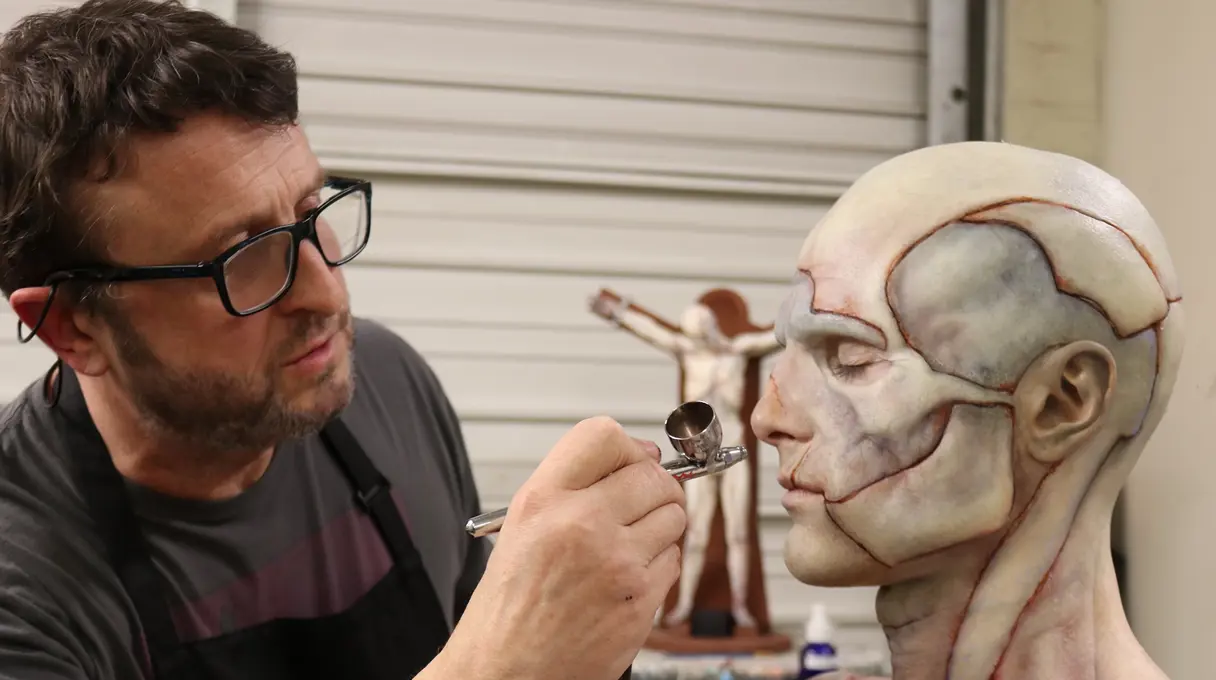

Forgoing the expected lumpy stitches and sunken eye sockets, Oscar-winning prosthetics designer Mike Hill discusses how he returned to author Mary Shelley’s original descriptions of the Creature for Guillermo del Toro’s sumptuous adaptation. By Clarisse Loughrey
‘There’s beauty in anatomy. There’s beauty in blood. There’s beauty in the inner workings of the human body,’ says Mike Hill, lead prosthetics artist on Frankenstein. ‘The Creature gets his hand blown open and we see his tendons and knuckles. To me, that’s beautiful architecture.’ Hill periodically dips into Gothic vernacular. You wonder whether he’s always spoken like this, or it’s simply a by-product of time spent marinating in the spectral wisdom of his director, Guillermo del Toro. As the designer explains, ‘We’re telepathically connected in some way.’
He’d already helped conceive a chiselled, screen-idol iteration of the Gill-man for 2017’s Best Picture winner The Shape of Water, and crafted macabre delights for both Nightmare Alley (2021) and the anthology series Cabinet of Curiosities (2022). But, for Frankenstein, del Toro tasked him with a most sacred duty: building a monster that could stand proudly at the heart of his labyrinth of misfits.
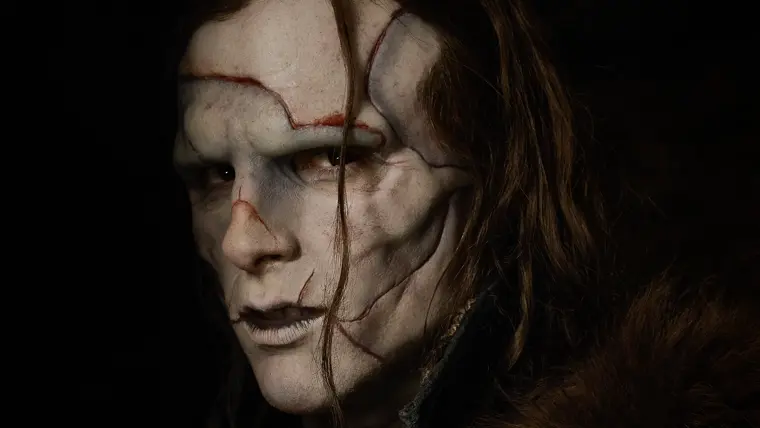
Which of the creations that populate del Toro’s 30-year career don’t channel the same sense of invention and macabre that emerged from the fervent imagination of Mary Shelley, as she conjured up her story on a chilly Genevan night in 1816? Hill’s Creature needed not only to liberate itself from a near century of Frankenstein pop culture – sparked by Universal’s clomping, flat-headed terror – and return to what Shelley first described (‘I had selected his features as beautiful. Beautiful! – Great God!’), but also reflect del Toro’s own uniquely romantic outlook.

His Creature (Jacob Elordi), after all, isn’t shunned entirely. Elizabeth (Mia Goth), whom Victor Frankenstein (Oscar Isaac) desires, sees the beauty inside the beast, which only makes his creator resent him more. ‘My thought pattern was, “This is Guillermo del Toro’s monster,”’ Hill says. ‘I don’t think it would fit into any other director’s world.’
All past incarnations, then, were set aside. The designer tried simply to think as Frankenstein does. ‘Victor’s trying to make the ultimate human,’ he explains. ‘That’s why he makes him of the tallest stature. That’s why he gives him a strong jaw, lovely cheekbones, great pecs. Is that the ideal man he wished he was?’

His body would be free of ‘ugly stitches’. Otherwise, ‘you’d think this person could have been in a road accident, and someone’s had to stitch him back together. I wanted to do geometric shapes and clean lines. They made a man. They’ve not repaired a man’. There’d be some imperfections, of course – after all, this is Frankenstein’s ‘first draft’.
Any monstrousness, then, should come from what Shelley depicts as uncanny imitation. ‘I think if you met him in person,’ Hill says, ‘he really was a dead man who’d been put together and brought back to life. There’s a vibe that you’d feel from him, like seeing a ghost.’ His sources of inspiration were ethereal – ‘alabaster statues’ and David Bowie’s extraterrestrial visitor in The Man Who Fell to Earth (1976). The sallow hues of the undead turned more colourful, too: a splash of yellow, as a nod to the novel’s description of him, and ‘a sky grey-blue’ in homage to the ghastly tint created for Boris Karloff’s iteration (in order to produce a greater contrast on black-and-white film).
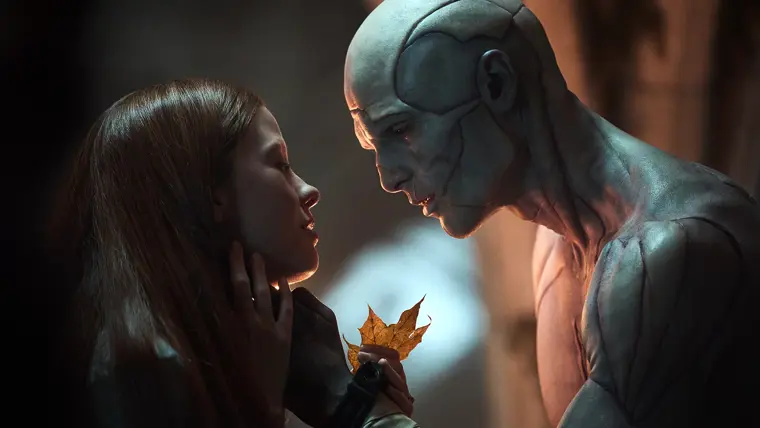
‘I saw him as a butterfly that, when the world hurts him, he becomes a moth,’ the designer says. ‘But, in the final scene, he’s back to being a butterfly again. So, I felt he needed colour.’ He placed a patch over his heart in the shape of a keyhole cover. ‘It’s almost like the window to his heart. And, if you look closely in the film, I put bloodstains, like his heart was always bleeding.’
All of this had originally been designed for Andrew Garfield, only for scheduling conflicts to force the actor out of the project nine weeks before the shoot. Frankenstein had a single shot at it. Del Toro had a second with Elordi, standing at 6ft 5, with a lean swimmer’s body and a steel-cut jawline. To Hill, he was ‘physically perfect for the character’.
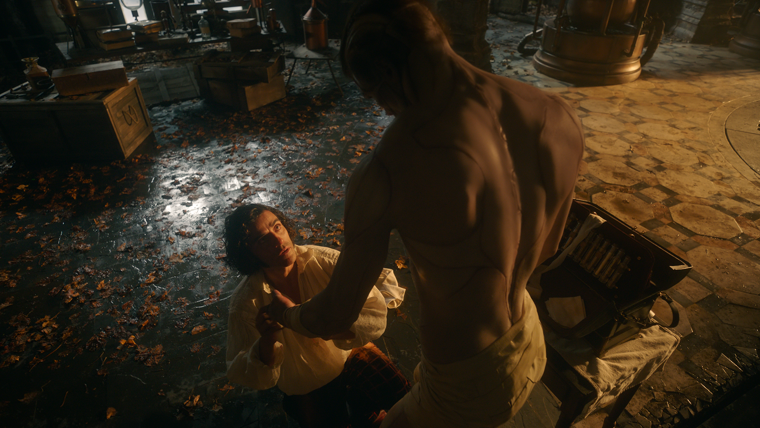
Elordi’s shoulders were broadened a little ‘to give him a hefty, more monstrous silhouette, but apart from that, it’s all Jacob, so the audience doesn’t know where Jacob ends and where the monster begins’. Hill avoided the typical dark, skeletal sockets in order for the actor’s eyes to better ‘speak’. ‘Jacob’s got these big, long lashes that are very much like Boris Karloff’s,’ he adds.
In the end, Hill crafted 42 separate ‘appliances’ that could take up to 10 hours to affix. He’d warned Elordi that ‘after a few weeks of this, you’re going to hate my face when I come in at 2am and I’m going to hate yours as well, because we’re both going to be exhausted. But you know what? That didn’t happen. We became best friends’.
Yet, there’s a question of who Hill really bonded with in those early hours. Under del Toro’s instruction, the actor would use the time to slip into character. ‘His movements became slower, more deliberate. Almost a grace came over him.’ It was Elordi who walked in, but even after 10 minutes of application, he’d be gone, replaced with ‘a creature. A kind, generous creature. So, I never knew Jacob for the first couple of months. I knew the Creature’.
This article originally appeared in the Awards Journal. You can pick up a free copy at your local Curzon cinema while stocks last.
RELATED ARTICLES
Deep Focus
Jacob Elordi’s Emotional Terrorists: On Elvis Presley & Nate Jacobs
Article
Tamara Deverell on her Nightmare Alley Production Design
Interview
Jessie Buckley & Chloé Zhao on Hamnet
By harnessing dreamwork and tapping into the subconscious, actress Jessie Buckley and writer-director Chloé Zhao respectively built a lived-in character and world for their poignant period drama. By Hannah Strong