
Shooting My Father's Island
Braving subzero temperatures, cinematographer Amine Berrada captures the savage beauty of a Norwegian winter for this affecting family drama.
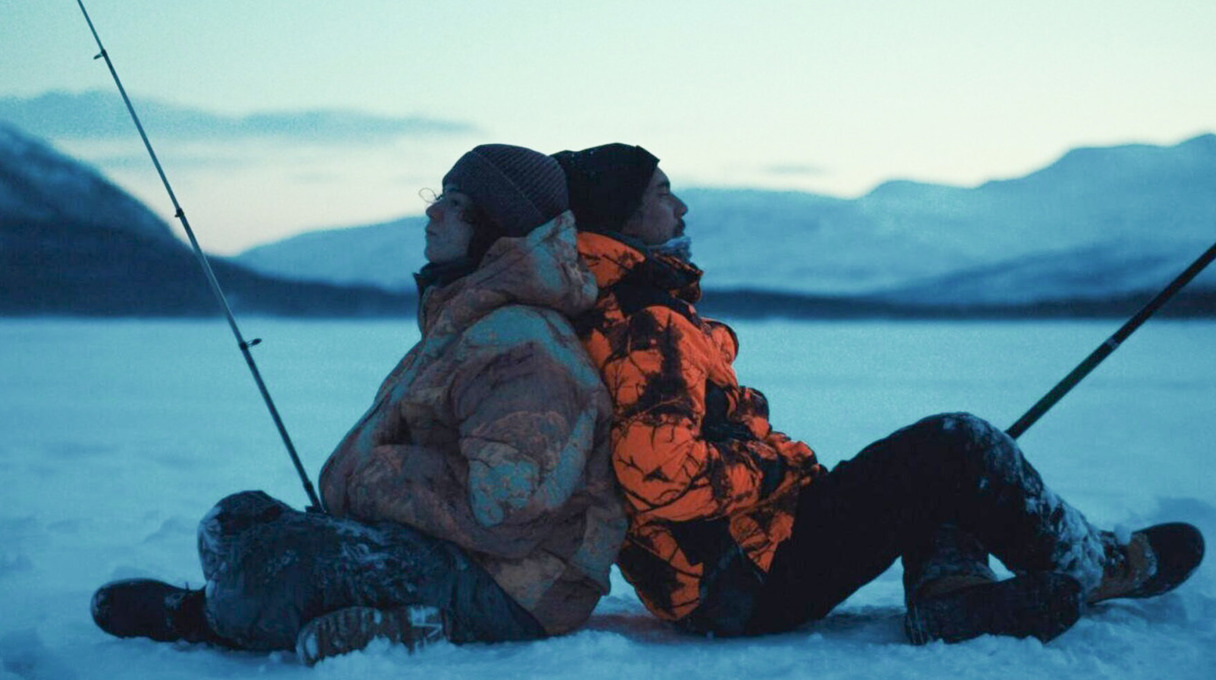
Every film set has its challenges, but cinematographer Amine Berrada likes things on the extreme side. From sweating under the heat of a remote Senegalese village for Banel & Adama (2023) to shooting entirely at night in the backstreets of Casablanca for Hounds (2023), he’s no stranger to a tricky work environment. But in the family drama My Father’s Island, Berrada had to contend with the brutality of a Norwegian winter, where temperatures average -25 degrees Celsius and the sun barely rises. ‘Everything we shot in the winter was really challenging,’ he says. ‘As everyone told us, it wasn’t impossible, just very hard. Sometimes you’d wake up in the morning and there would be a metre of snow! How do you walk with a camera in a metre of snow? We had to learn to adapt.’

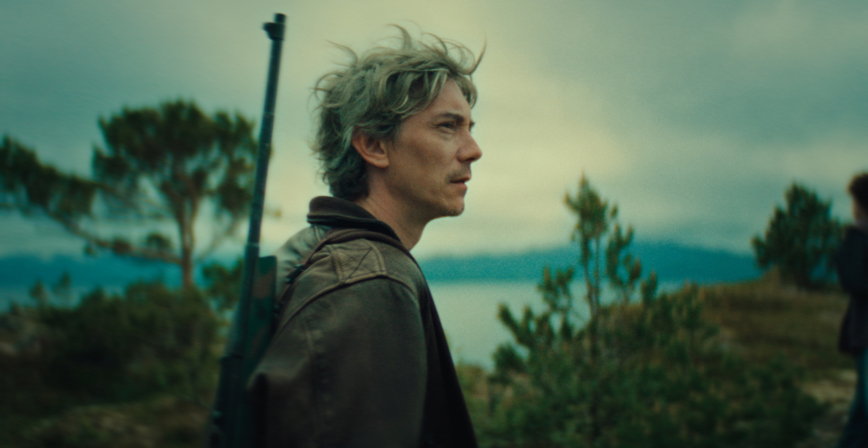
Based on a novella by David Vann, My Father’s Island begins with a young man named Roy, played in his early teens by C’mon C’mon’s Woody Norman, remembering an ill-fated adventure with his father years ago. The story unfolds in flashback, with his irresponsible father Tom (Anatomy of a Fall’s Swann Arlaud) whisking him off to a cabin on an uninhabited island in the fjords. Tom is enamoured with off-grid living, but it soon becomes clear that he is not as adept at this lifestyle as he let on. What starts as a seemingly idyllic summer, with the two bonding, turns into a harsh winter; Tom's grip on reality starts to loosen, and fractures in their relationship begin to form.
Berrada worked closely with writer-director Vladimir de Fontenay to create a look for the film that would capture the harsh, isolated beauty of the landscape, as well as the psychological turmoil both characters experience. ‘We talked a lot about Andrea Arnold’s movies, like American Honey [2016] and Fish Tank [2009],’ he says. ‘The camerawork in those films is really immersive and there’s so much sensitivity there.’
My Father's Island is in Cinemas from 3 July
Book Tickets HereBerrada shot on the Arri Alexa Mini partly handheld, lending a sense of immediacy to the images. But he and de Fontenay certainly weren’t seeking total realism for this story within a story, utilising anamorphic lenses with their slightly distorted images for a dreamlike feel. ‘It instantly tells us that this is not a documentary. This stylised approach aligned with the core feeling of the film. The lenses also create this weird distance between the characters, and these amazing flares.’ He also looked at Paris, Texas (1984) to consider how to incorporate vivid, sometimes unnaturalistic colours into scenes set at night to reflect the characters’ fluctuating emotional states.
Berrada had the idea that the cabin itself was like a visualisation of Tom’s brain; at times bright and warm, at times a dark and chaotic space in which Roy is trapped. To express how erratic his mood becomes, in one sequence, Berrada lit Swann Arland three different ways in quick succession as he paced through the cabin, moving from a cool exterior light, to silhouette, to an exaggerated burst of red from a curtain. ‘I loved lighting this scene,’ he remembers. ‘When he turns to face his son, who’s blocked into the corner, it’s like he’s a predator – like we don’t really know who he is.’

One less obvious inspiration was Gerry (2002), Gus Van Sant’s divisive experiment with slow cinema in which Matt Damon and Casey Affleck play two friends who become fatally lost in the desert. ‘There’s one shot we talked about so many times,’ Berrada enthuses. ‘It’s a shot of one of the characters who is so tired, and you feel that mentally he’s at the end of his capacity. There’s a circular tracking shot focused on his face. It’s so powerful, and we literally copied it because we loved it so much – and it fitted perfectly with what we wanted to achieve at that moment of the movie.’
But making My Father’s Island wasn’t all trudging around in the snow. Berrada recalls the thrill of shooting the scene when Roy first arrives on the island via a very small plane, and is treated to spectacular views over the fjords and neighbouring islands. ‘It was my time in a plane like that, and I was on my own with the camera – no focus puller, no gaffer – because there was just no space. It was just the professional pilot, one actor at a time, Vladimir [de Fontenay] and me. It was amazing, like you were in another world’.

My Father’s Island is as much a trip into the wilderness as it is into the fissures of a mind in turmoil, and Berrada’s exquisite cinematography allows the audience to journey with Roy as he reckons with this troubled relationship with his father.
MY FATHER'S ISLAND IS IN CINEMAS FROM 3 JULY
RELATED ARTICLES
Interview
Dream Therapy: Carla Simón on Romería
Director Carla Simón discusses dreams, memories and the importance of looking back with Sophia Satchell-Baeza.
Interview
The Love That Remains: A Family Affair
Hlynur Pálmason talks about working with his own family to bring this poetic, lightly surrealist drama to life while employing his visual-art sensibilities to explore the highs and lows of family life.
Interview
Director Oliver Laxe Wants You to Feel Sirāt in Your Body
A knife-edge existential drama, Cannes winner Sirāt is one of the awards season’s most strikingly original films. The filmmaker behind it talks spirituality, ceremonial dancing and the choreography of images with Ian Haydn Smith.