
The Live-Action Super Mario Bros Movie is so Much Better Than You Remember
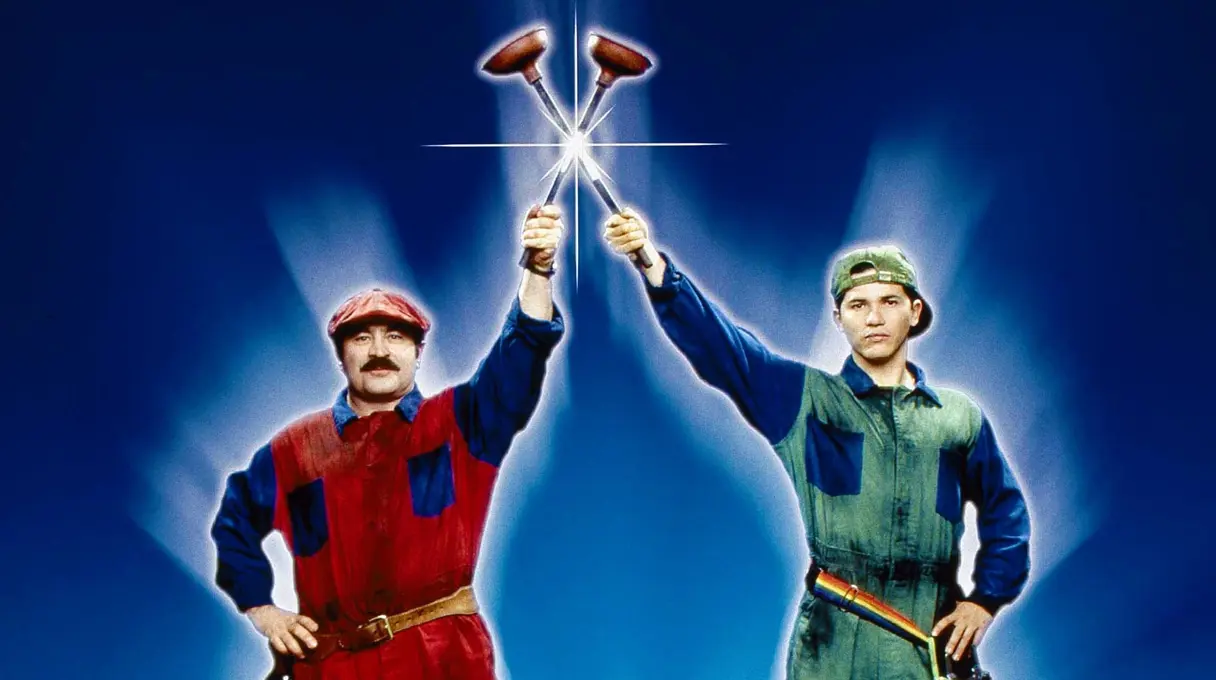

David Opie makes the case for the often maligned Nineties adaptation of the Nintendo video game, which, although not wholly successful, isn’t afraid to get weird.
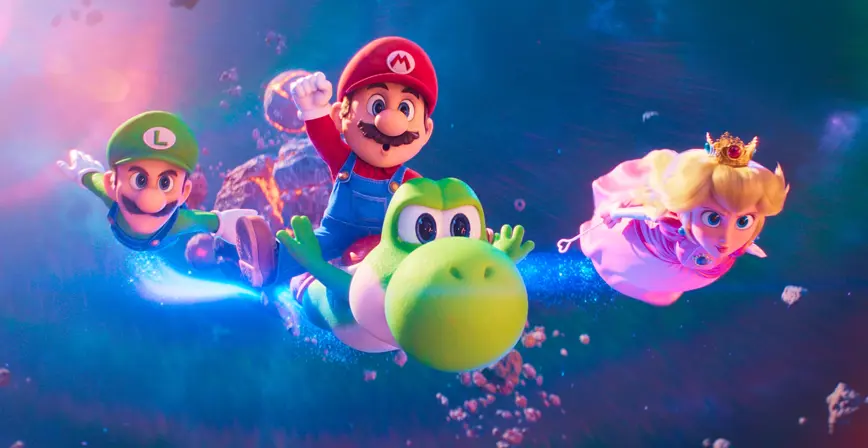
He’s-a back! Mario and his brother Luigi have returned in The Super Mario Galaxy Movie, an animated sequel to 2023’s blockbuster smash where they fight the Bowser clan in outer space. For those new to the franchise, expect a ton of jumping, moustache-twirling and considerable earnings if the success of the previous film is anything to go by.
The Super Mario Bros. Movie ground-pounded the box office in 2023, quickly becoming the third highest-grossing animated film worldwide and the highest-grossing film ever based on a video game. That Mario – and other recent game adaptations like Detective Pikachu (2019) and Sonic the Hedgehog (2020) – were hits finally dispelled the notion of a so-called ‘video-game curse’ (assuming that such a thing ever existed). Popular wisdom was revised: in the right hands, these movies could do big business.
WATCH THE SUPER MARIO GALAXY MOVIE IN CINEMAS
Book TicketsEven when films like BloodRayne (2005) and House of the Dead (2003) bombed in the Noughties, other adaptations such as Resident Evil (2002-2016) and Silent Hill (2006) proved that there was always scope for video game-inspired storytelling on the big screen – and that’s only become clearer over time as the two mediums continue to converge.
Yet talk of a ‘curse’ has persisted for decades regardless, and much of that stems from Hollywood’s first attempt at bringing Mario to cinemas. Three decades before The Super Mario Bros. Movie became the most successful video-game film, a very different, live-action take on everyone’s favourite Italian plumber was deemed the worst. What husband-and-wife directors Rocky Morton and Annabel Jankel ended up creating with Super Mario Bros. (1993) was almost unrecognisable to casual Mario fans used to playing Nintendo games on their SNES.

Mario (Bob Hoskins) and Luigi (John Leguizamo) were still brothers and plumbers in this version, that much is true, but the film rips them out of their Mushroom Kingdom and plonks them in a bizarre parallel universe where dinosaurs have evolved to rule over a post-apocalyptic New York City. President ‘King’ Koopa (Dennis Hopper) throws a spanner in the works when he kidnaps a woman named Daisy (Samantha Mathis) who, it turns out, is descended from the prehistoric denizens of Dinohattan. For various reasons, his end goal is to merge these two realms so he can rule over them both, wiping out all mammals in the process.
For those unfamiliar with Mario, this is not how the games go. Not even slightly. The Super Mario Bros. Movie is far more faithful to the source material in that respect and, as a result, it plays things safer. The new films are essentially the games in animated form with nary a dinosaur in sight (save for Yoshi, of course, who arrives in the sequel). By all accounts, these animated takes on Mario’s story had a much easier time of it during production, too. In fact, bringing Super Mario Bros. to screen was harder than driving drunk backwards down Mario Kart’s Rainbow Road track, mirrored on 200cc, no less.

Nine different writers were attached in total, starting with Barry Marrow who had just won an Oscar for his Rain Man (1988) screenplay. Co-producer Fred C Caruso recalls that the original script was too serious, telling LA Times, ‘We were looking for the same audience that enjoyed E.T. as well as Ghostbusters as well as Terminator 2 and Batman.’ Multiple rewrites before, and even during, production threw the shoot into disarray. ‘The script had probably been rewritten five or six times by the time I arrived here,’ Hopper revealed on set in that same 1992 interview. ‘I don’t really bother with it anymore. I just go in and do it scene by scene. I figure it’s not going to hurt my character.’
‘The first script I got was witty,’ added Fiona Shaw, who played Koopa’s queen, Lena. ‘That was maybe 10 scripts ago.’ Discontent with the writing and the direction of the film drove John Leguizamo to drink whiskey between takes (as he admits in his autobiography). The end result lives on in infamy as one of cinema’s greatest disasters, pulling in just $38 million worldwide against a $48 million budget. The only people who seemed to hate Super Mario Bros. more than contemporary critics were the people who worked on it. Co-director Rocky Morton’s abiding memory of the film is ‘humiliation’, while star Bob Hoskins has repeatedly described it as ‘the worst job he ever agreed to’.
It’s no wonder Nintendo waited so long before trying again with another Hollywood spin on its greatest mascot. But that’s not to say the original film is without merit. Just as Koopa tried to join two different worlds in his quest for greatness, so too did the directors, who struggled between the serious intentions of the original script and the child-friendly comedy that was added in subsequent versions.

‘There’s the original film that was my intention,’ Morton later told Nintendo Life, ‘but all of that was lost […] and you can see the problem that that would have caused, trying to merge these two universes together.’ Yet there’s something about this creative tension that helps separate Super Mario Bros. from other supposedly ‘failed’ video-game adaptations.
While movies like Warcraft and Assassin’s Creed (both 2016) opted for a bland, underdeveloped interpretation of the games they were inspired by, Super Mario Bros. feels truly alive in all its messy contradictions. Dinohattan, for example, is tangibly real thanks in large part to Blade Runner (1982) production designer David L Snyder. Sparks flying, TV screens buzzing, oddly dressed citizens scurrying between oppressive buildings… this neo-fascist hellscape might have nothing to do with the games, and yet it’s undeniably intriguing.
Such intricate world-building also adds some dark humour, like the woman walking her pram with a large egg inside before it’s stolen by a predator. Everything is strange and off-kilter, matching the tone that is cruel one minute and nonsensical the next. Your heart will break for Yoshi, enslaved here by Koopa, and then you’ll stare dumbfounded at Mario and Luigi as they do a few of their signature jumps using rocket-powered boots.

While most failed video-game adaptations inspire boredom or sometimes revulsion, it’s a lot harder to quantify exactly what you’re supposed to feel when this version of Mario seduces a club owner by explaining that he likes to get punched in the face. How could you not be entertained?
Super Mario Bros. is much smarter than you’d expect. Somehow, even through the endless rewrites and chaos on set, there are scenes that dare to go a little deeper, as when Mario cries out against the cops who arrest a guy protesting Koopa’s dictatorship. That alone is far more effective than any given scene in Warcraft.
The same is true of the central relationship between the brothers. ‘Mario brought me up,’ Luigi tells Daisy at one point. ‘He’s been my father, my brother, my uncle, everybody.’ With this comes a refreshing positivity that shines through the bleakness, daring to defy the edgy ‘grimdark’ aesthetic that’s otherwise prevalent here, and in most fantasy and sci-fi from the early Nineties.

As easy as it is to jump on the hate train, Super Mario Bros. remains far more inventive than it’s given credit for. Like other live-action adaptations from that era, including Teenage Mutant Ninja Turtles (1990) and The Flintstones (1994), Super Mario Bros. makes for a flawed yet fascinating watch that doubles as an artefact of its time before unnecessary CGI took precedence. Not everyone agrees, though. Mario creator Shigeru Miyamoto once told Edge that Super Mario Bros. ‘became a movie that was about a video game, rather than being an entertaining movie in and of itself’.
Sure, Super Mario Bros. might not be the most successful video-game adaptation of all time, and it certainly isn’t the best – it’s not even the best version of Mario on screen. But what you cannot deny is how entertaining this film is. Whether you’re coming to it with nostalgia, losing yourself in the manic world-building, or just laughing at its sheer audacity, Super Mario Bros. might well be the most entertaining video-game adaptation ever made. And that’s-a-true, regardless of quality.
WATCH THE SUPER MARIO GALAXY MOVIE IN CINEMAS
RELATED ARTICLES
Review
Project Hail Mary Review: Ryan Gosling Shines in Sci-Fi Buddy Comedy
Piloting this star vehicle with practised finesse, the actor transforms his lovable-idiot astronaut into a selfless empath in Lord and Miller’s initially silly, ultimately poignant space movie. By Yasmin Omar
Article
The Best Video-Game Adaptations Speak the Medium's Language
Ahead of Borderlands, Billie Walker considers how the recent uptick in video-game adaptations has led to an adoption of the medium’s immersive, first-person aesthetics – both within this subgenre and beyond.
List
15 of the Best Animated Movies
From the revered, fantastical animated features of Studio Ghibli to Walt Disney’s hand-drawn masterpieces, the medium presents infinite possibilities. Here, we share our favourite animated movies.