
A Child of My Own: The True Story of a Fake Pregnancy

Director Maite Alberdi discusses her genre-straddling docudrama, which explores a woman’s unorthodox attempt to become a mother. By Laura Venning
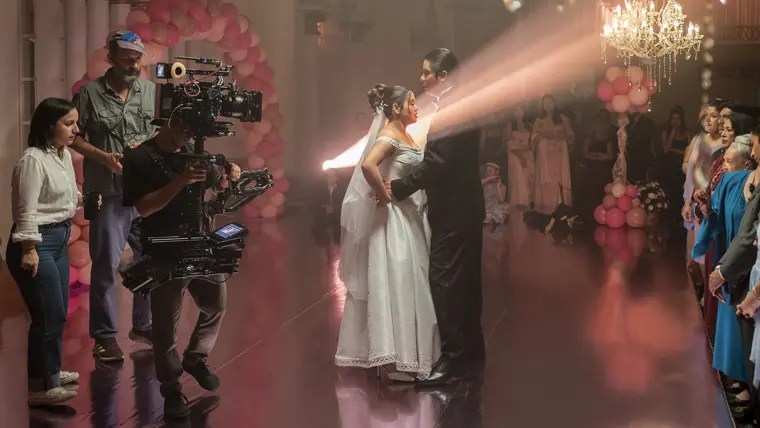
In crackly home-video footage dated 29 July 2000, a 17-year-old Mexican bride walks with nervous determination, hoisting her skirt. She smiles shyly through the ceremony, the posed photographs and the confetti-throw alongside her new husband Arturo. We then see that same bride, Eleonor Alejandra Marín Mendoza (Ale for short), some 25 years later recall her wedding day. She was pregnant, and full of excitement to fulfil – as she saw it – her feminine destiny of becoming a wife and mother.
WATCH A CHILD OF MY OWN IN CINEMAS
Book TicketsBut as Ale explains this directly to camera, we see a montage of different young women speaking her exact words, the sound of their voices overlaid. Finally, when actress Ana Celeste is echoing Ale’s profound desire to have a baby, the fourth wall is broken and a director appears, asking her to ‘try a version that flows a little more [because] this is an interview we’re trying to imitate’. The filmmaker is casting Ale at the age of 17, a blushing bride with no idea of what patriarchal societal expectations would drive her to do.
This is the bold approach of Chilean director Maite Alberdi, who here makes a brief cameo as herself. Alberdi happened to meet Ale in a prison while she was researching a different project and she was captivated by Ale’s stranger than fiction true story: she successfully faked a pregnancy, but was then jailed for over a decade for stealing a newborn baby from the hospital where she worked as a nurse. ‘It’s a tragedy,’ says Alberdi, ‘because she begins exactly where women are supposed to be in society and ends up at what people see as the lowest point. But, at the same time, it’s a funny, ridiculous story.’
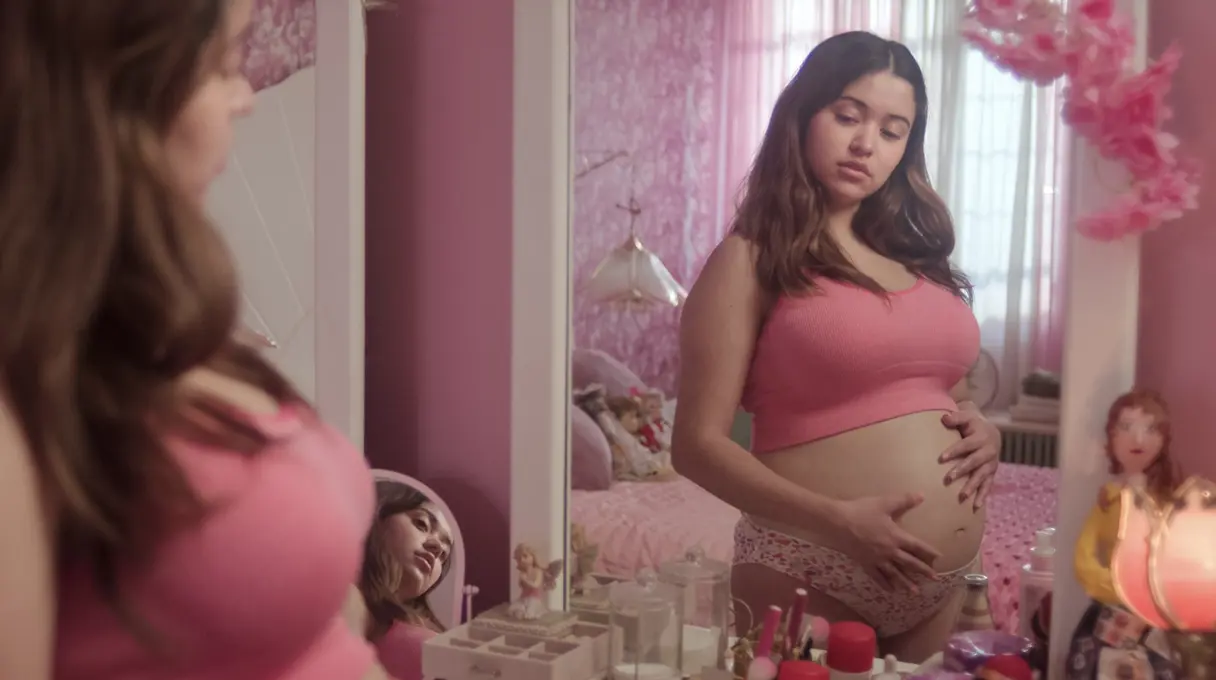
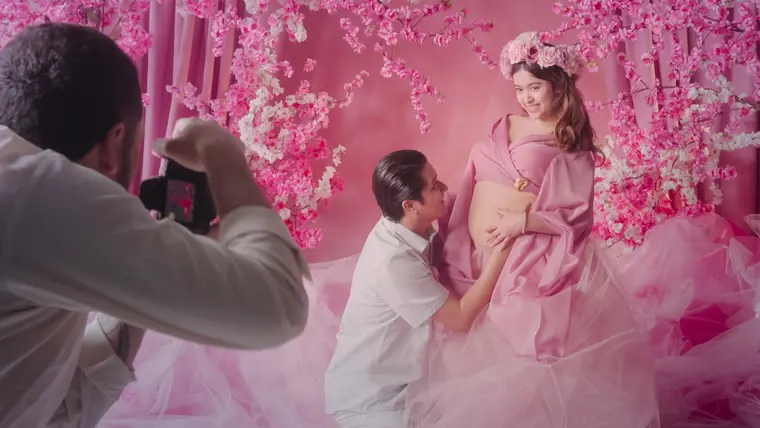
A Child of My Own tells Ale’s tale in reconstructed scenes of the early years of her marriage, dramatising how one little lie would eventually lead to her becoming Mexican tabloid fodder. In these scenes, Alberdi draws her audience into this teenage bride’s world, reflecting her naivety with soft focus and a colour palette of warm pinks as Ale hoodwinks her husband, extended family and even doctors into believing she’s pregnant, deliberately gaining weight to maintain the illusion.
It feels closer to farce than conventional documentary. ‘I think this style represents my journey with Ale and with the film,’ says Alberdi. ‘I don’t define the film as a documentary exactly. The first part’s more of a representation of her subjective reality and the story she tells herself to survive. It’s her fairy tale.’
Alberdi initially only heard Ale’s version of the events, which took place in the spring of 2009. To this day, she maintains that there was no kidnapping: she’d made a deal with a pregnant woman named Mayra to adopt her unwanted baby and pretend it was hers, something Mayra vehemently denies. Alberdi was shocked and dismayed to realise that Ale wasn’t telling the whole truth, and the harsh reality of her arrest and long stint in prison soon punctures this comedic melodrama.
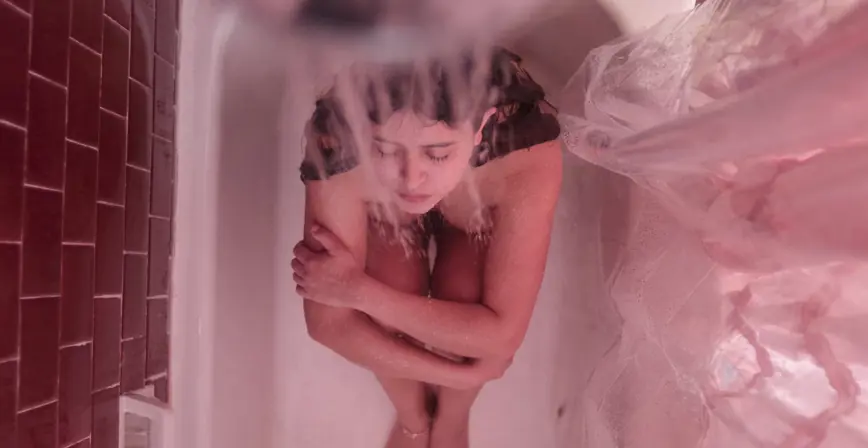
But the filmmaker also sympathised with Ale as a vulnerable young woman who acted out of sheer desperation and had endured immense loss, having had multiple miscarriages and never received any support for her mental health.
‘What really connected with me was the question of why someone would fake a pregnancy for nine months, and the invisible social pressures women constantly experience, especially in Latin America as a culture of maternity,’ Alberdi says. She portrays the scorn Ale endures from her in-laws at her failure to produce a child, which quickly switches to adoration when she appears to finally be pregnant.
Then there’s her husband Arturo, who refuses to consider adoption, despite the trauma of Ale’s miscarriages, because he’s obsessed with his biological lineage, a child of his own. ‘A lot of men think that way but they never say it so explicitly,’ Alberdi says, with a sigh. ‘And he never changed his mind even after everything, it was so painful to me, that pressure on women is constant.’
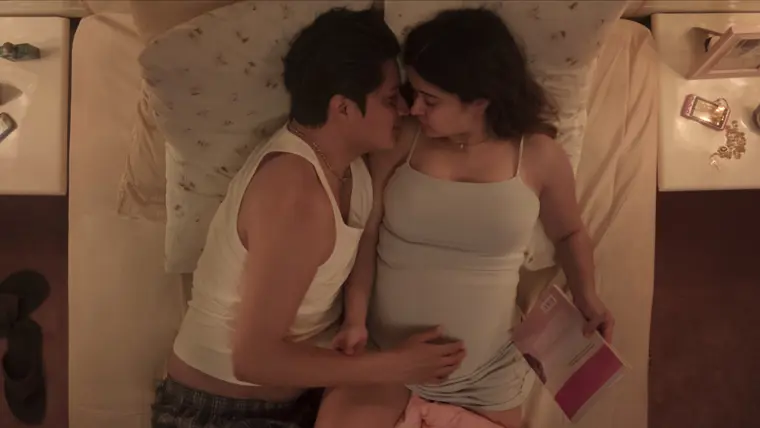
Given her previous films, it’s no wonder Alberdi was intrigued by this high-drama narrative that blurs the boundaries between fiction and non-fiction, mixes genres and represents the unseen struggles of Latin American women. Her Oscar-nominated The Mole Agent (2020) was both a sobering documentary about isolated elderly women confined to a nursing home and a jaunty comedy about an octogenarian spy.
The Eternal Memory (2023) was more a documentary about the fragmentary nature of memory than it was about Alzheimer’s, and her first foray into narrative features was In Her Place (2024), a dramatisation of a real murder trial through the lens of a feminist fable. For Alberdi, real-life stories are more intriguing because they don’t obey the limits of genre. ‘Reality is comedy and tragedy, you wake up in the morning, funny things happen and you also feel sad, it’s just life. It’s more interesting to mix emotions, everything is more complex.’
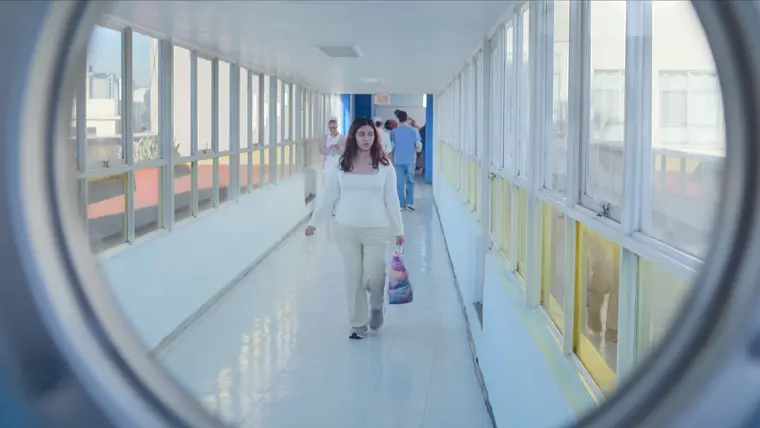
A subgenre of women-led films and series about scammers and con artists, often based on real cases, has emerged recently, including titles like I Care a Lot (2020), Inventing Anna (2022), The Dropout (2022) and Apple Cider Vinegar (2025). There’s even a pregnancy-scam subgenre, with Amy Schumer’s Kinda Pregnant (2025), the BBC podcast series The Con: Kaitlyn’s Baby (2026), and novels like Diary of a Void (2023) and Motherfaker (2026).
Why do we love these narratives of manipulation and deception so much? ‘I think that there is some mechanism that all of us construct to survive, a version of ourselves that we tell ourselves,’ Alberdi says. ‘Sometimes we live a life in our mind so we can connect with a version of ourselves that we want to be. I think we love these stories because we can connect with that desire to lie.’
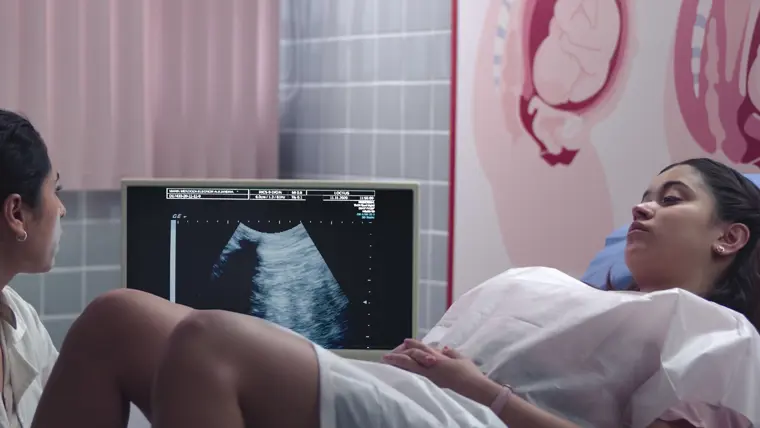
Audiences, especially women, have certainly been responding to the film. ‘The Q&As have been very tender,’ she says. ‘I’m asking people to understand a criminal, someone very removed from themselves, but they really connect and feel moved by her. In Mexico, women have been crying and sharing their own stories.’ A Child of My Own neither excuses nor condemns its unlikely heroine, who served a long prison sentence. Instead, this bittersweet docudrama offers empathy, humour and heart.
WATCH A CHILD OF MY OWN IN CINEMAS
RELATED ARTICLES
Article
How Christopher Nolan Became a Brand
As the director follows up his Oscar-winning Oppenheimer with The Odyssey, Matt Maytum considers how the filmmaker achieved his status as a singular visionary who shoots on celluloid, favours practical effects and makes event movies out of the unlikeliest of subjects.
Article
How Big Tech Became Animation’s Ultimate Supervillain
From Ron’s Gone Wrong’s data-mining CEO to Toy Story 5’s attention-sucking AI tablet, there’s been a surprising surge of anti-billionaire techno-pessimism in recent family films. Alistair Ryder investigates the trend.
Review
The Invite Review: An Old-School Comedy of Marital Manners
Olivia Wilde returns to form with a stripped-back, adroitly performed character piece that feels like a Seventies movie, writes Yasmin Omar.