
Dog Day Afternoon’s Complicated Queer History


Laura Venning examines Sidney Lumet’s bank-heist thriller through a queer lens, considering the film’s contentious place in the LGBTQ+ canon as well as its enduring New Hollywood pedigree.
Is there a more visceral, more feverish summer film than Sidney Lumet’s 1975 classic Dog Day Afternoon? Audiences that year were newly terrified of beach holidays thanks to Jaws and its paradigm-shifting invention of the blockbuster as we know it, but a grittier, more subversive and more confrontational portrait of an all-American summer would follow it just three months later.
On 22 August 1972, 27-year-old John ‘Littlejohn’ Wojtowicz attempted to rob a bank in Brooklyn, New York City, aiming to steal the equivalent today of $1.5 million. What was supposed to be a rapid in-and-out job descended into a 14-hour standoff with police and the FBI, with Wojtowicz and accomplice Salvatore Naturile holding seven bank employees hostage.
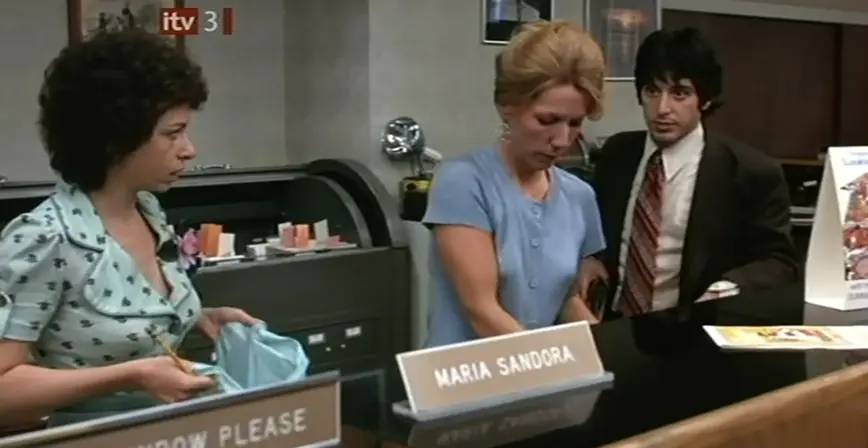
WATCH DOG DAY AFTERNOON IN CINEMAS
Book TicketsThis shambolic heist on a roasting summer’s day became a media sensation thanks to Wojtowicz playing up to the cameras, and even more so after the revelation that his motive was a desire to pay for gender-reassignment surgery for his transgender wife Elizabeth Eden. Three years later, Lumet and screenwriter Frank Pierson would bring what was seen at the time as a beyond salacious story to the big screen, with Al Pacino playing Sonny Wortzik, closely based on Wojtowicz.
Dog Day Afternoon’s poster, featuring a wide-eyed Pacino with pitch-black hair plastered to his sweaty forehead, has adorned many a university bedroom wall. Pacino’s roles in films like The Godfather (1972), Scarface (1983) and Heat (1995) have certainly cemented him as an icon of flawed but almost mythical masculinity; his best-loved characters have a rotten nobility akin to that of a doomed Shakespearean king. And although Dog Day Afternoon’s Sonny fits that mould, the film also occupies a second, almost opposing position as a rather contentious but still significant piece of queer cinematic history. This dichotomy helps make it one of the most interesting and enduring entries in the New Hollywood canon, an era of daring, zeitgeist-shaping American films that spanned from the late 1960s to the early 1980s.
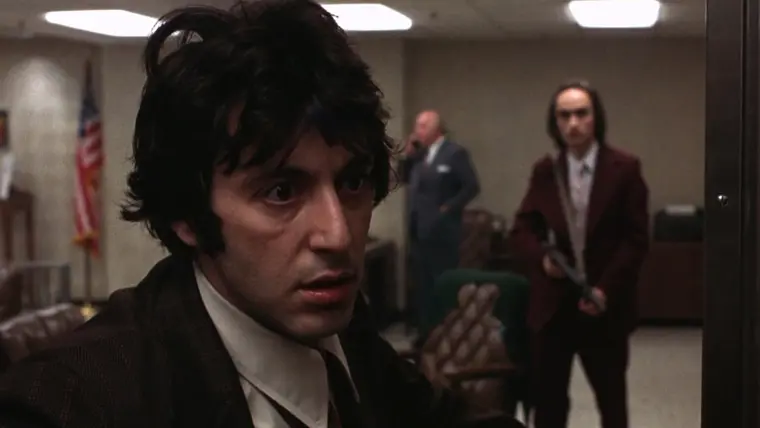
In his groundbreaking 1981 book The Celluloid Closet: Homosexuality in the Movies, author Vito Russo lambasts Dog Day Afternoon as ‘the ultimate freak show, a film that used the sensational side of a true story to titillate a square audience’. It’s not an unfair criticism; Sonny’s motive for the robbery is not made clear from the outset and his queerness is treated as a shocking twist. We learn at the same time as the police that when he asks for his wife he’s not referring to the estranged mother of his children but a trans woman named Leon (Chris Sarandon), who he has also married. As audience members, we’re positioned here to identify not with Sonny himself but with the mob outside the bank who aren’t altogether pleased to learn that their new hero is a gay man, even less so when a group of vocal gay-rights activists arrive.
At this point in his career, Pacino had already been nominated for two Oscars and, soon after production on Dog Day Afternoon wrapped, would be nominated a third time for The Godfather Part II (1974). An actor in his position could afford the ‘risk’ of being suspected of being gay himself by playing a character like Sonny, especially one who isn’t tortured by his own queerness and doesn’t care when he’s outed on live television.
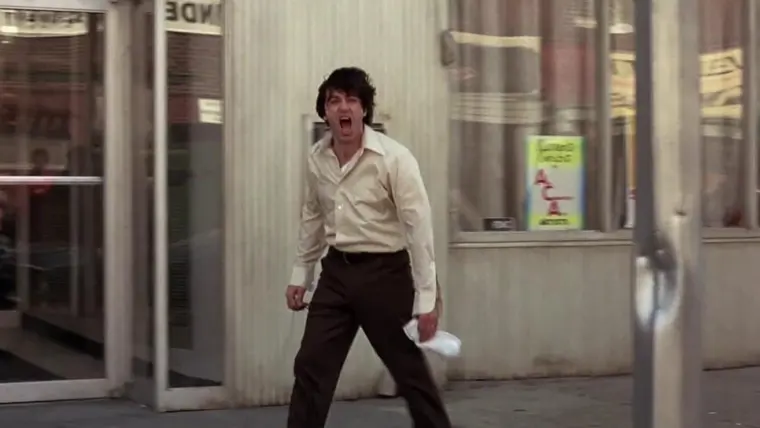
Unsurprisingly for the era and lack of understanding around transgender identity, the film was initially regarded as a story of two male lovers before Leon was thankfully rightfully reinterpreted as a trans woman. Sarandon, a cisgender man, won the role over trans performers like Elizabeth Coffey, a John Waters collaborator who was told she was ‘too female’ to play the part, and it’s troubling to hear Sarandon describe Lumet’s direction as ‘a little less Blanche DuBois, a little more Queens housewife’.
But although Sonny and Leon only share one scene, during which they speak to each other on the phone, it’s absolutely riveting – the beating heart of the film. They’re both tender and frustrated with each other, and Pacino and Sarandon each manage to conjure a vivid image of their relationship in our minds, even as they never actually share the same space. To the film’s credit, their romance isn’t presented as laughable or perverted, just doomed, and both halves of the couple are essentially sympathetic.

The film’s legacy is further complicated by this sugar-coating of Sonny and Leon’s relationship when the real John Wojtowicz was not nearly as affable or charismatic as the version portrayed by Pacino. As displayed in the 2013 documentary The Dog, he was egotistical, hungry for fame and openly admitted to embellishing the truth to tell a better story. Eden later claimed she’d never loved him. Dog Day Afternoon also neglects to mention that Wojtowicz needed to pay off a debt to the Mafia, to do so would be to pollute the image of a chaotic but lovestruck Robin Hood.
Dog Day Afternoon would go on to be nominated for seven Oscars, including Best Picture and Best Actor for Al Pacino, and would win Best Original Screenplay. Most notable was Sarandon’s nomination for Best Supporting Actor, an early example of many accolades cisgender actors would receive over the years for playing transgender characters. Decades later, Pacino played another noteworthy queer figure for better or worse, that of closeted, morally bankrupt lawyer Roy Cohn in Mike Nichols’ adaptation of Angels in America (2003).
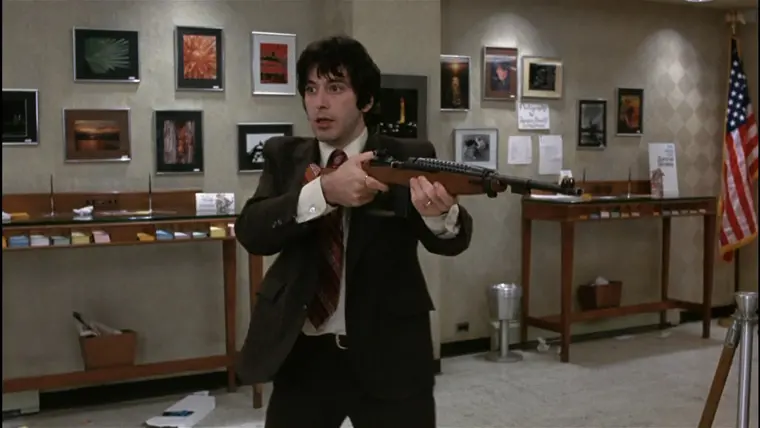
The legend of John Wojtowicz/Sonny Wortzik and his all-consuming love for a trans woman seems to have endured far beyond the less romantic truth, largely thanks to Sidney Lumet’s brilliant direction and Al Pacino’s electrifying performance. And perhaps that’s how the film is best viewed by LGBTQ+ audiences today: as an evocative anti-authoritarian and profoundly tragic folk tale, rather than an honest portrayal of a significant moment in queer history with clearly identifiable heroes and villains, oppressors and underdogs.
WATCH DOG DAY AFTERNOON IN CINEMAS
RELATED ARTICLES
Article
City Heat: An Exploration of Urban Cinema
With our newest Film Club strand, Summer in the City, beginning in August, Guy Lodge celebrates some of the finest evocations of sunbaked cities on film.
Interview
Amadeus: Rebel Genius
As Miloš Forman’s Oscar-winning drama returns to cinemas, Joshua Bell, the music director of the orchestra that recorded the original soundtrack, the Academy of St Martin in the Fields, welcomes the film’s unexpectedly mischievous portrait of Mozart.
Article
Horror Movies Insist Orphans Are Evil – Bring Her Back Disagrees
The Philippou brothers’ latest film subverts the tired genre trope that parentless children are sinister interlopers and master manipulators seeking to destroy their adopted families, writes Miriam Balanescu.