
La Grazia Offers a Surprising Portrait of Italian Politics
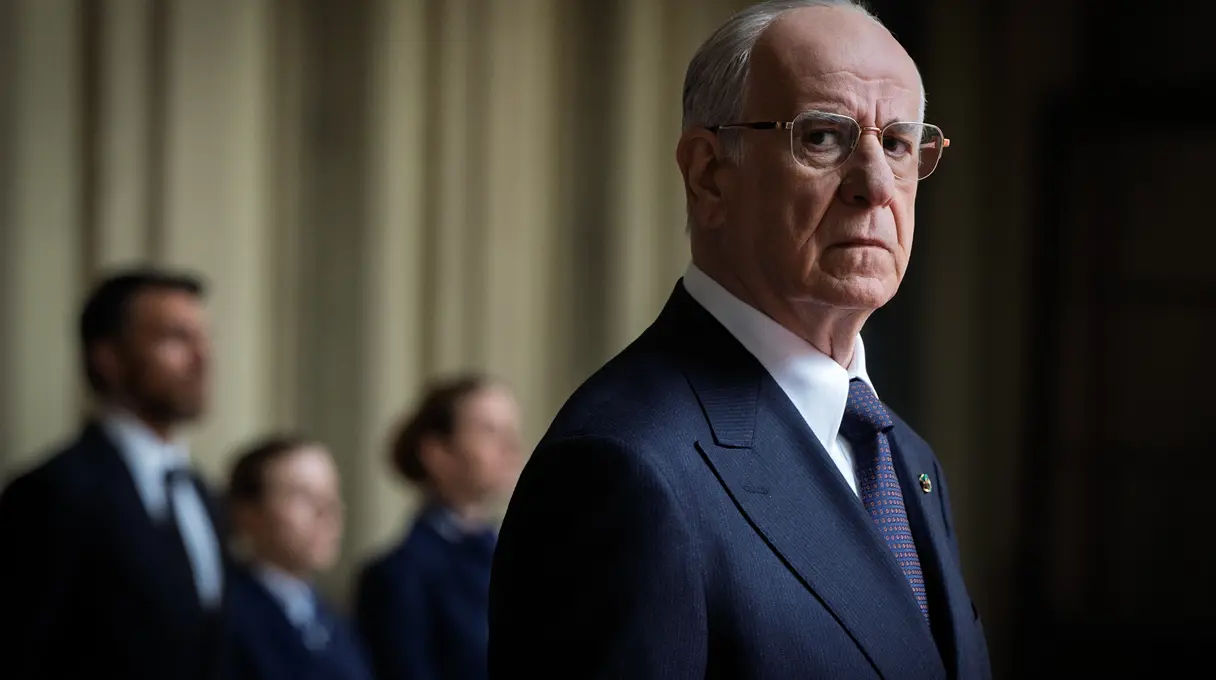

Paolo Sorrentino’s new drama, his seventh with actor Tony Servillo, presents a refreshingly atypical portrait of an Italian president, for whom power is more of an enervation than an aphrodisiac, writes Ian Haydn Smith.
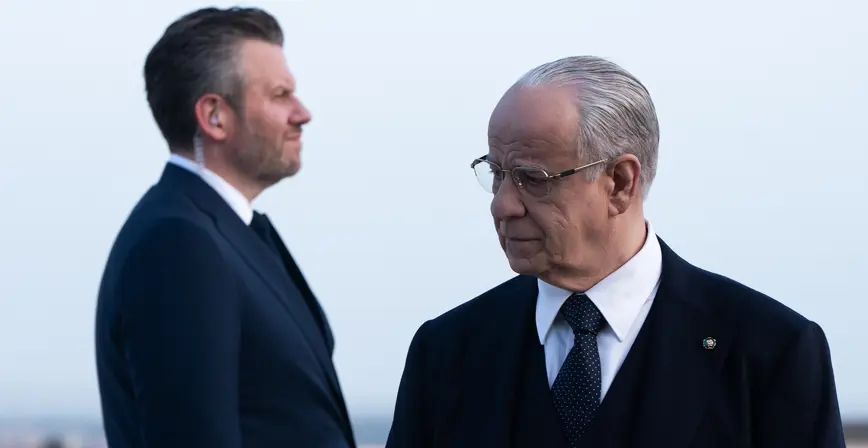
President Mariano De Santis (Tony Servillo) faces the twilight of his time in public office. Having entered the semestre bianco (‘white semester’, or final six months) of his seven-year term, his powers have been significantly reduced. Nevertheless, he faces two landmark decisions: whether to sign into law an act that will legalise euthanasia, and choosing to pardon two individuals convicted of murder.
The decisions are hardly helped by De Santis’ rigid Catholicism and apparent preference for rumination over decisive action. There is also the spectre of his long-dead wife, whose apparent infidelity both haunts and taunts him. In lesser hands, so many weighted issues might sink a film. But Paolo Sorrentino tackles them with an understatement that results in arguably his best film in a decade. It’s also a commentary on how politics has shifted in our world.
WATCH LA GRAZIA IN CINEMAS
Book TicketsItalian cinema was once a hotbed of political provocation and discussion. For almost 40 years, from the late stages of World War II up until the mid-1970s, the country’s best filmmakers shone a light on their society: its mores and hypocrisies, governance and instability, revolutionary fervour and profiteering elites. The political establishment eventually neutered filmmakers’ power by controlling the modes of production.
A less radicalised, more controllable, and socially and culturally conservative cinematic landscape emerged – one that mirrored the country’s own changing politics. The decades that witnessed the disparate but politically engaged talents of Roberto Rossellini (Rome, Open City, 1945), Vittorio De Sica (The Bicycle Thieves, 1948), Federico Fellini (La Dolce Vita, 1960) and Michelangelo Antonioni (L’Eclisse, 1962) seemed gone. Some filmmakers continued in a political vein, but they were in the minority. Then, in the 2000s, a new generation emerged, led by Sorrentino, who seemed intent on reviving this kind of cinema.

La Grazia is the director’s third film to grapple directly with the vicissitudes of Italian political life, but the first whose protagonist is entirely fictional. His 2008 political drama, Il Divo, was a darkly witty and stylish biographical portrait of Giulio Andreotti, intermittently the Italian Prime Minister across six governments between 1972 and 1992. Andreotti’s career encompassed almost every major political position and his power – both legal and, by association with the country’s sprawling organised-crime network, illicit – was expansive. In Sorrentino’s film, thanks to Servillo’s outrageous performance as Andreotti, the former leader (who was still alive when the film was released) is presented as a nefarious, crepuscular figure with a passing resemblance to Max Schreck’s Nosferatu.
Il Divo captures Andreotti during his final election in 1992, as he reflects on his tumultuous career, a failed bid for the presidency, and the various scandals that rocked his standing and tarnished his reputation. The film is surprisingly frank in dealing with the statesman’s links to organised crime (even though the courts acquitted him of all charges), and is unwilling to shy away from the uglier side of Andreotti’s time in power. A sardonic character study, Il Divo is a high point in Sorrentino’s body of work.

Blistering satire also underpins Loro (2018), Sorrentino’s sprawling, two-part portrait of Silvio Berlusconi that, once again, stars Servillo. No other Italian statesman has succeeded in emboldening his international reputation as the three-time Prime Minister, media magnate and self-styled playboy who enjoyed the nickname Il Cavaliere (‘the knight’) from those who adored him.
An early example of a modern populist leader, Berlusconi courted outrage with his views, opportunism and lifestyle. Loro draws together an assembly of real-life and fictional characters, from Berlusconi’s personal and political circles, as it sculpts a portrait of a time when his power was waning, his marriage was failing and the glitzy lifestyle he projected was a smokescreen for unbridled greed.

If the first part rattles along at a fair pace, the second – by the sheer expansiveness of Berlusconi’s interests, activities and ambitions – can only cover in broad strokes what Il Divo accomplished in detail. Nevertheless, it remains more direct than the hazy focus and tonal unevenness of the filmmaker’s first attempt at an English-language drama, 2011’s This Must Be the Place, which saw Sean Penn’s faded, Robert Smith-lookalike rock star decide to hunt down a Nazi war criminal. Loro is certainly more successful than that curio, but there are moments when Berlusconi slips through Sorrentino’s fingers.

Politics, albeit of a more tangential kind, has been a constant in other Sorrentino films. The embittered antagonist of The Family Friend (2006), in which an avaricious property owner receives his comeuppance at the hands of his tenants, can be seen as an example of the way the economically impoverished have been used by the wealthy. Their misanthropy – and, in a further link with Loro, misogyny – is barely concealed as they lord their advantage over those in need, their exploitation passed off as charity. Giacomo Rizzo is magnificent in the lead and the film’s stylishness (its opening is one of Sorrentino’s finest) is beyond doubt, but the film is a bitter pill that most audiences found hard to swallow.
In his most acclaimed film, the Oscar-winning, Felliniesque The Great Beauty (2013), Sorrentino eviscerates Rome’s intellectual and cultural class. A carnivalesque exploration of privilege, it’s presented through the jaded perspective of Servillo’s Jep Gambardella, a once promising novelist. Jep is revealed as someone who sold his talent down the Tiber in favour of Rome’s easy money as a columnist and easy sex as an outsized wit in a pond of sycophants. His reminiscences of an earlier love and more innocent times only highlight the vacuousness of his present-day existence.

Servillo’s president in La Grazia shares certain characteristics with Jep, particularly a longing for a past unsullied by intimate betrayal. But they are ultimately very different: De Santis no longer revels in the thrill of life and, crucially, possesses a moral compass that so many of Sorrentino’s other protagonists (including Jep) sorely lack.
His upstanding character aligns him more closely with former banker Titta Di Girolamo (Servillo), a solitary long-term resident of a Swiss hotel in The Consequences of Love (2004), the director’s international breakthrough. Titta’s chequered past finds him trapped there, a pawn to powers intent on punishing him for gambling away their money. But his moral compass is strong and he decides to grasp at an opportunity to change things – if not for himself then for others that he sees have suffered.

De Santis also comprehends the challenges that face him and the opportunity he has to make changes. Whether he does is the crux of the film, alongside the wider relevance of La Grazia with our contemporary political climate. At present, populist politics continues to ride a wave of approval across the globe. Authoritarian leaders – from prime ministers and presidents to oligarchs, plutocrats and tech bros – claim to represent the views of their populace, employees or followers.
De Santis seems to hail from an earlier tradition. If he doesn’t quite fit the mould of a classic liberal leader as imagined by Aaron Sorkin (Jed Bartlet in The West Wing or Andrew Shepherd in 1995’s The American President), he remains a leader who believes his power is not his to own and use to his own advantage, but a responsibility bestowed on him temporarily and which he must use wisely. That it proves overwhelming only highlights how corrosive it could be in the wrong hands.

As a former judge, De Santis understands the importance of knowing all the facts. But as a president, one whose nickname is ‘reinforced concrete’, his experience allows him to recognise which actions are best for the country and not for those who lead it. He might not be the finest leader, but Sorrentino is implying that, with Italy’s track record, De Santis would, at the very least, be a step in the right direction.
WATCH LA GRAZIA IN CINEMAS
RELATED ARTICLES

Review
Project Hail Mary Review: Ryan Gosling Shines in Sci-Fi Buddy Comedy
Piloting this star vehicle with practised finesse, the actor transforms his lovable-idiot astronaut into a selfless empath in Lord and Miller’s initially silly, ultimately poignant space movie. By Yasmin Omar
Article
It’s About Time a Female Director Depicted the Bride of Frankenstein
For nearly a century, male filmmakers have misrepresented Mary Shelley’s female creature, stripping away her voice, complexity and bodily autonomy. Here, Nadira Begum outlines the patriarchal overtones of these interpretations, and looks ahead to Maggie Gyllenhaal’s reinvention of the character in The Bride!
Interview
Jessica Henwick: I've Been Really Creatively Fulfilled Working with New Directors
The How to Make a Killing star discusses prioritising independent-film projects, preparing for her directorial debut and leaving hustle culture behind. By Josh Slater-Williams