
Director Oliver Laxe Wants You to Feel Sirāt in Your Body
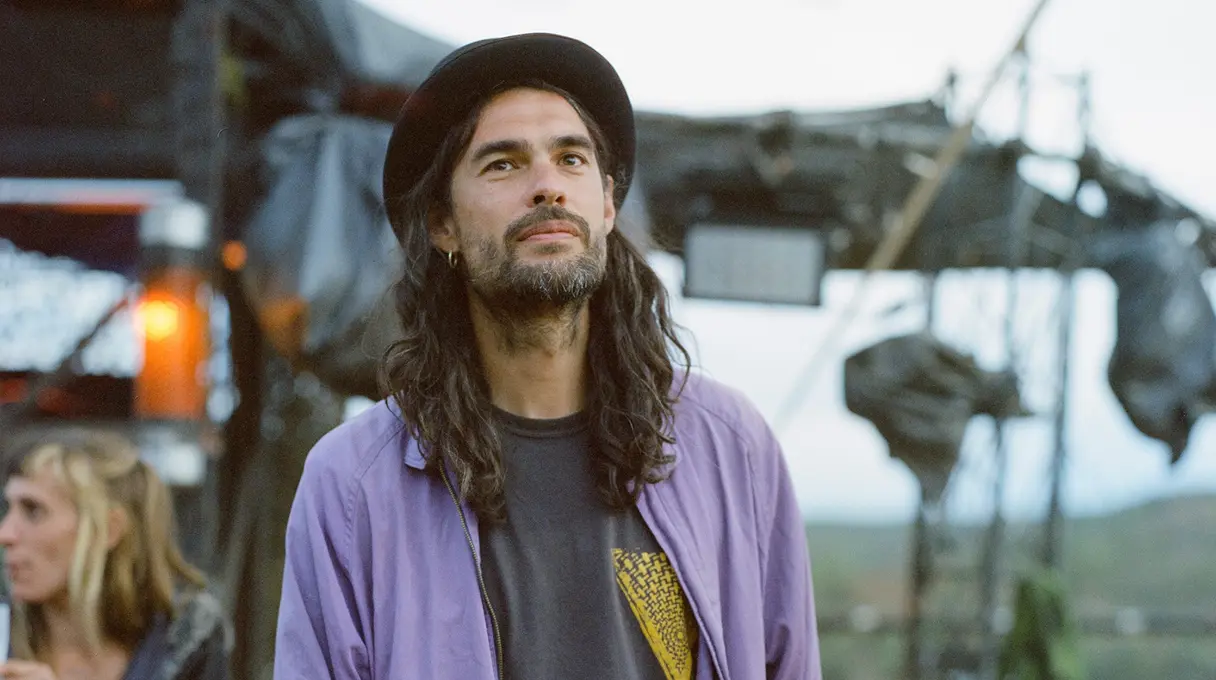

A knife-edge existential drama, Cannes winner Sirāt is one of the awards season’s most strikingly original films. The filmmaker behind it talks spirituality, ceremonial dancing and the choreography of images with Ian Haydn Smith.
With certain films, a plot description does little, if anything, to convey the experience of watching them. Their power lies in what cannot be communicated – the act of ‘feeling’ sounds and images; of being immersed in a world that is recognisably ‘real’, yet transcends the boundaries of any conventional lived experience. Here, the physical journey characters embark upon is less crucial than their spiritual one.
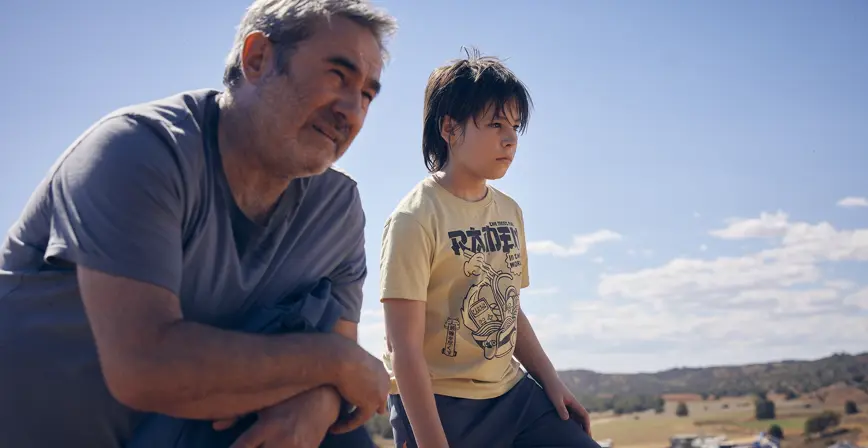
In Oliver Laxe’s Oscar-nominated Sirāt, a father has travelled from Spain to Morocco with his son in search of his missing daughter. He believes she might have joined a group of itinerant revellers, which is why they find themselves at the foot of a mountain, on the edge of a vast desert, attending a rave. However, the sudden presence of the army suggests something is amiss. The father’s decision to join a breakaway group of travellers, disobeying the military’s orders and journeying deeper into the desert, has irrevocable consequences.
WATCH SIRĀT IN CINEMAS
Book TicketsSirāt is a sensorial audiovisual experience. It is a narrative film, but that narrative is subservient to Laxe’s desire to immerse us in the spiritual and emotional, as well as physical, world of his characters. The film feels unique, yet Laxe rails against the idea that it is groundbreaking in any way. ‘I don’t identify with this idea in modernity of creating something new, of radically changing cinematic language,’ he insists. ‘We don’t have to. We have been making films for over a century, often in a really beautiful way. I’m not worried about being original. Or being different.’ Nevertheless, what he achieves with his fourth feature feels strikingly different, even from his previous work.
A Cannes darling, Laxe followed his much admired 2010 debut, You All Are Captains, which won the FIPRESCI Prize in the Critics’ Week strand, with Mimosas (2016), which picked up the top prize in the same competition. Both are set in Morocco (Laxe was born in France to parents from Galicia and has spent much time in North Africa). Where his first film focuses on socially excluded children in a Tangiers foster home, Mimosas goes off the beaten track and into the Atlas Mountains. It is an oblique yet compelling tale – or, as the director describes it, a ‘religious western’ – that embraces mysticism.
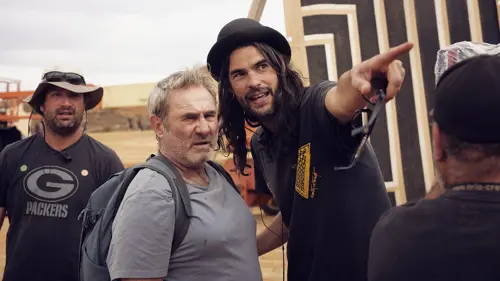
It also highlights his brilliance at reading the stories written on the faces of his mostly non-professional cast. Laxe’s third film, 2019’s Fire Will Come, which also won at Cannes (the Jury Prize in Un Certain Regard), centres on a man who returns to his rural Galician home after serving prison time for arson. In this intense study of a small farming community, Laxe employs imagery to startling, at times even surprising, emotional effect. Sirāt goes further.
‘The first images that comprise this film came to me when I was travelling in 2011,’ he says. ‘I was thinking about a place where people are dancing. A place where you are connected with the collective consciousness. It felt like I was fishing. I was in this place, dancing, but closing my eyes and fishing for images.’
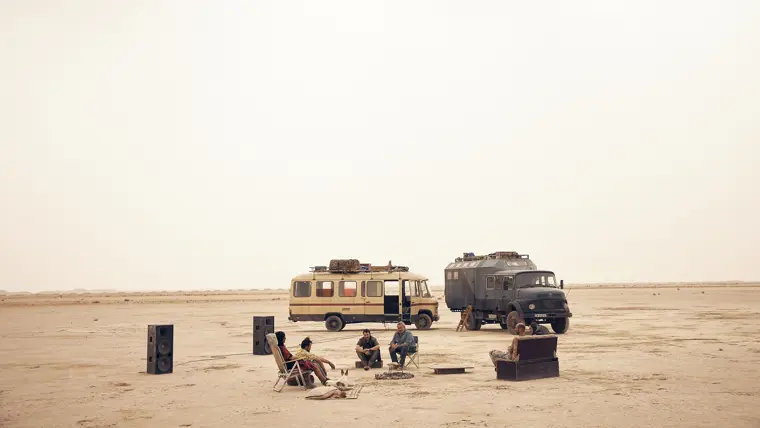
Another of his journeys suggested the storyline that threads through the film, in which the desperate father (Pan’s Labyrinth veteran Sergi López) risks everything to find his daughter. ‘In 2012, I travelled to Mauritania and Senegal. During this journey, the structure of the film began to take form. It felt like it would be a kind of pilgrimage.’ It’s an apt description of Sirāt, which takes its name from the Arabic word for ‘path’ or ‘way’ and, in Islam, refers to the bridge that connects this world and Paradise.
Working for a third time with co-writer Santiago Fillol, Laxe adopted a less-is-more approach to crafting the script. ‘I have a deep, profound trust of images. When I’m writing with Santiago, we always aim for fewer pages. We know that fewer pages means more cinema.’ The result, Laxe feels, is a film that resembles ‘a symphony or opera, in terms of the energy that comes out of each scene. We were trying to achieve not just the most from the images, but get as close as possible to the images that I first envisioned. It’s not always easy, but I want to find the shortest point between what I first imagined and what you see on the screen. We want people in cinemas to feel the images and the sounds with their bodies’. There is dancing on the screen, but Laxe also feels that there is a ‘choreography between the images and the spectator’.
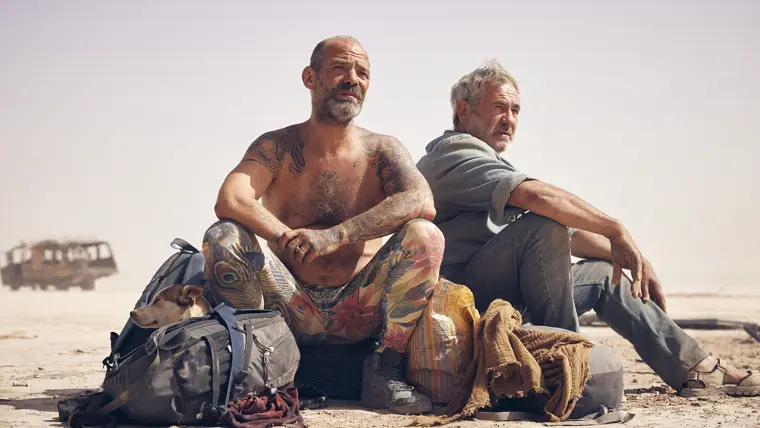
The journey the characters take – resulting in one of the most thrilling and visceral films of the last year – becomes a metaphysical exploration of the relationship between the body and the surrounding environment. ‘It’s the way I see the world,’ Laxe explains. ‘I think we are praying with our bodies. I began Gestalt therapy [a form of psychotherapy that prioritises individual experience in the present] and I believe that the body gives us information about the world. We’re connected to it in many different ways – not all conscious or obvious – through our bodies.’
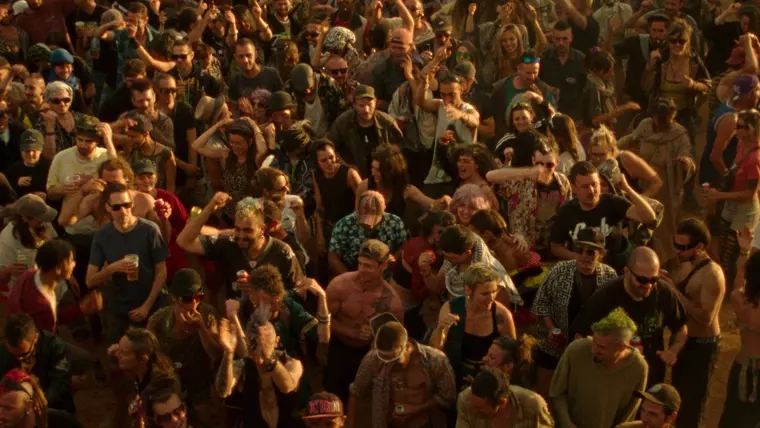
Laxe conveys this perfectly through the film’s dance scenes. Sound – and particularly music – is as important to the film as the images. ‘First and foremost, the images in the film dance,’ Laxe says. ‘Every image you see is related to sound in some way. Right from the outset. The way I write is to capture atmosphere. And music, at its heart, is atmospheric.’ Laxe worked with acclaimed DJ and composer Kangding Ray, whose propulsive, hypnotic tracks at the start of the film give way to something deeper as the travellers journey into both the desert and themselves. ‘The script was littered with references to music that I wanted to use. Many of them were tracks by Kangding Ray. The music he wrote takes us from the cathartic physicality of the techno that we hear early on, to something far more ethereal and transcendental. The ambience of the later tracks edges closer to a kind of sacred music.’
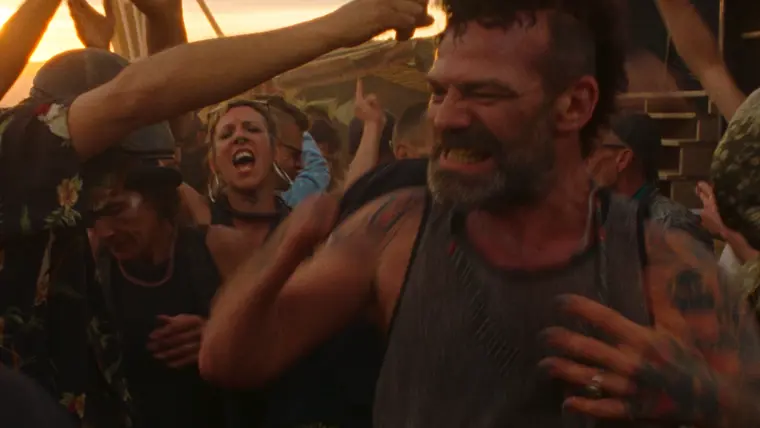
Nowhere is that sense of transcendence clearer than when, later in the film, the small group dances alone, each wrapped up in their own universe. Outside of López, Laxe cast people he had encountered on his travels, many at raves. Like his previous work, he chose people whose experiences are etched into their faces and bodies, which further emboldens his fascination between the corporeal and the spiritual. And this scene – one of the standouts in a film not short of memorable moments – is key. ‘When you see the actors dancing alone in the desert, which we shot in the seventh week of production when we were all physically and psychologically tired, they were at their limit. What they were doing was something deeper than just moving to the music. It felt like a ceremony. A ritual.’
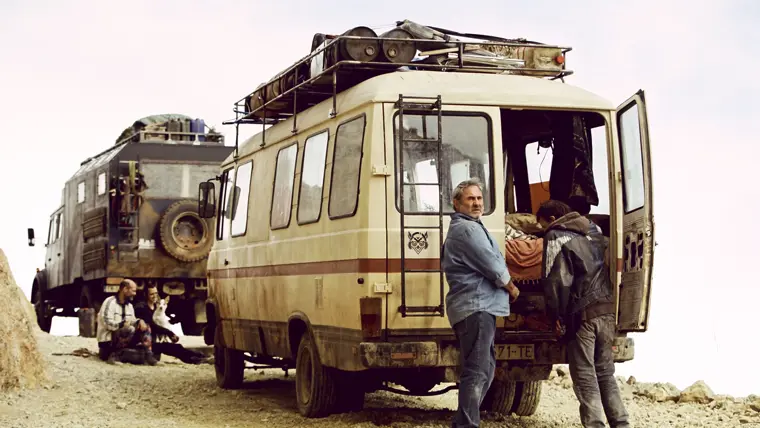
Reaching for the meaning in his film (but reeling at the idea that any film is just ‘about’ something), Laxe references the climactic moment of Russian director Andrei Tarkovsky’s penultimate feature Nostalghia (1983). ‘That scene, where the main character is walking back and forth through an empty mineral pool, carrying a candle, in an attempt to achieve some kind of transcendence, was a strong influence. We wanted the audience to experience catharsis. In my spiritual practice, the aim is to become a zero. And I like that idea, of achieving nothingness. I feel that, at the end of Sirāt, we see people who are humbled. [They] have become, in a way, zero in the world. I would like audiences to feel like that.’
In its aim and execution, Sirāt is a wildly ambitious film. And it’s as close to the original images Laxe envisioned for it. ‘I am really happy with what we achieved. It’s exactly the film I intended to make. Yes, there were certain instances where I couldn’t go as far as I wanted. I wasn’t yet at that point in my career where I was able to do that. Perhaps with my next film I will be able to include everything.’